
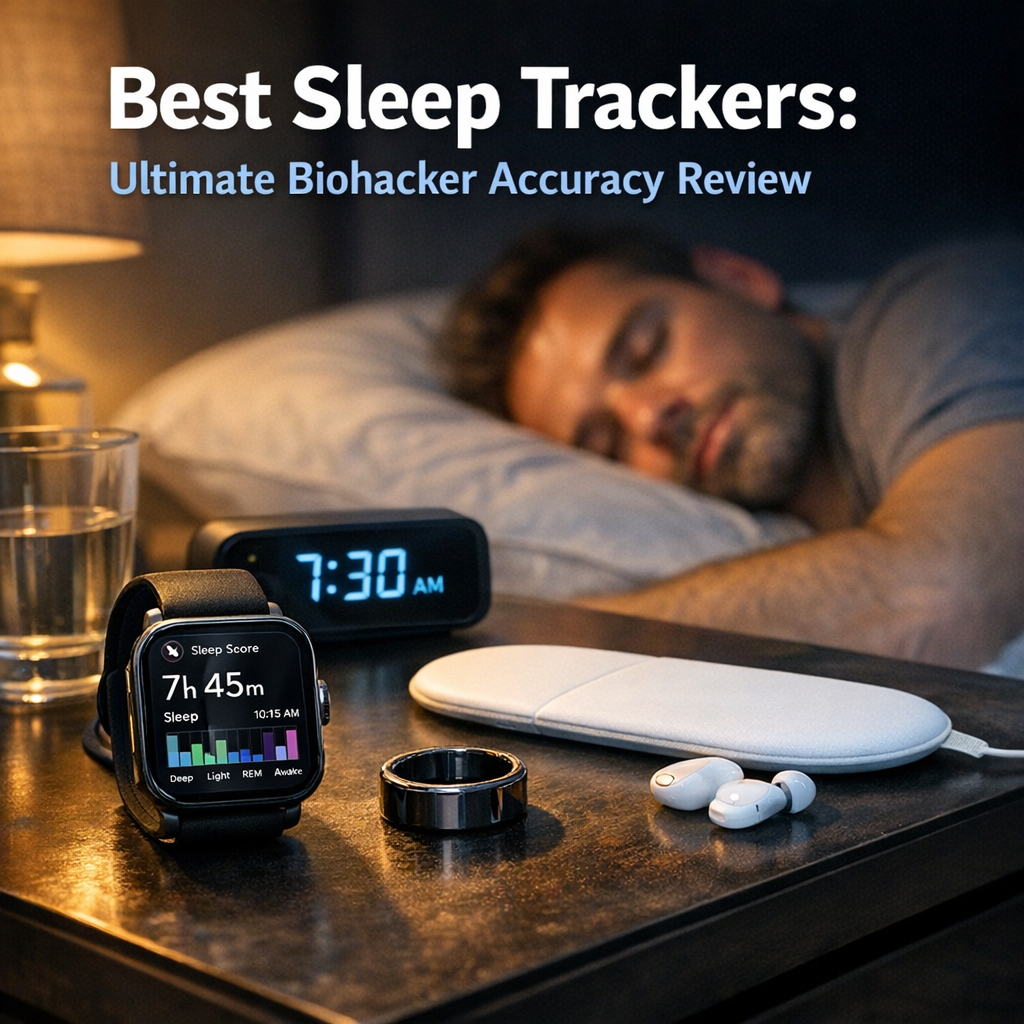
- For the most accurate sleep tracking and stable Heart Rate Variability (HRV) baseline, the Oura Ring is the champion, with studies showing its sleep staging metrics are comparable to clinical Polysomnography (PSG).
- The WHOOP Strap 4.0 is best for performance athletes and managing the Work-to-Rest Ratio, providing actionable *Recovery* and *Day Strain* scores for training optimization.
- The Apple Watch is excellent for a broad health snapshot and ecosystem integration but generally lacks the precision of dedicated devices for granular Sleep Quality Metrics (REM/Deep Sleep).
- True biohacking requires a “stack”: pair your wearable’s data with internal biomarker diagnostics (e.g., blood panels from services like Life Force) and targeted recovery interventions (e.g., Infrared Sauna Blankets or Cold Plunge Tubs).
Table of Contents
- The Accuracy Standard: Consumer Wearables Versus PSG
- Why Inaccurate Data Kills Your Biohacking Efforts
- The Three Heavy Hitters: Which Wearable Technology Can You Trust?
- The Metrics That Matter: Data for True Health Optimization
- Data Utility: Which Platform Provides Actionable Insights?
- Expanding Your Biohacking Toolkit Beyond Wearables
- The Segmented Verdict: Which Tracker is Right for Your Biohacking Goal?
- Hack Your Biology: Building the Ultimate Biohacking Stack
- The Final Word on Wearable Technology
- Frequently Asked Questions: Biohacking Accuracy and Tools
Have you ever spent hours optimizing your diet, crushing your workouts, and perfecting your sleep hygiene, only to have your wearable device tell you that you’re totally depleted? It’s incredibly frustrating, isn’t it?
If you’re deeply committed to biohacking and serious about health optimization, you know the pain of trusting bad data. You spend all that time on self-experimentation, tracking every variable, only to get a funky recovery score.
The core mission of biohacking falls apart the moment your data turns out to be inaccurate. If you’re using flawed information to try and hack your biology, you’re not optimizing; you’re just wasting time and effort.
We aren’t interested in flashy notifications or massive subscription bundles here. We want to know one thing: which wearable provides the most scientifically valid, actionable physiological data tracking for the advanced user?
When we talk about optimizing health, we need accurate sleep tracking and reliable metrics. A simple fitness tracker that just guesses your sleep stages isn’t going to cut it for serious optimization.
We need to see how the top wearable technology devices (the Oura Ring, the WHOOP Strap 4.0, and the Apple Watch) measure up against the clinical gold standard.
Can these biohacking products truly provide the data utility necessary for a deep dive into your recovery? Let’s define the accuracy standard and see who wins.
The Accuracy Standard: Consumer Wearables Versus PSG
If you’re relying on a device to help you optimize health, you need to understand its limitations. The gold standard for measuring sleep quality is Polysomnography (PSG), which uses advanced EEG Devices to measure brain waves, eye movement, and muscle activity.
Consumer fitness trackers can’t use full electroencephalography (EEG) because, well, you don’t want to sleep wired up like a lab experiment. So, they use photoplethysmography (PPG) sensors to estimate metrics like Heart Rate Variability (HRV) and respiratory rate.
This is where noise and movement artifacts cause major problems. A slight shift in the ring’s position or an active dream state can easily confuse the algorithm, leading to misclassification of critical Sleep Quality Metrics, like REM and Deep Sleep.
But here’s the good news: some devices are getting incredibly close to clinical accuracy, especially regarding sleep staging.
For example, a 2020 study highlighted that the Oura Ring’s ability to capture metrics like sleep stages, latency, and disturbances is remarkably comparable to medical-grade equipment. This makes it a powerful tool for serious self-experimentation for optimization.
We need to look beyond raw heart rate. We need devices that accurately measure complex metrics like Heart Rate Variability (HRV), skin temperature, and Blood Oxygen Saturation Monitoring (SpO2) 24/7. That’s the real measure of a great tracker.
And speaking of continuous tracking, battery life is critical, isn’t it? If your device is dead, you lose valuable overnight data. The Oura Ring typically lasts around 7 days per charge, often featuring a 20-minute quick charging capability.
The Whoop Strap 4.0 is also built for continuity, lasting 4 to 5 days, emphasizing that continuous tracking of physiological data is non-negotiable for true biohackers.
Related Video
Best Wearables for Sleep: Scientific Rankings
We will see which devices are good at tracking your deep sleep, REM sleep, and light sleep, and which devices are just terrible. You can also learn more about best sleep trackers.
Watch Video on YouTube →
Why Inaccurate Data Kills Your Biohacking Efforts
That’s why consumer wearable technology, like the Oura Ring and the Whoop Strap 4.0, rely on a different approach: consumer-grade AI sleep tracking devices.
The Three Heavy Hitters: Which Wearable Technology Can You Trust?
If you want a broad health overview and seamless integration with your phone and other fitness trackers, the Apple Watch is a powerful tool. But for deep, granular self-experimentation requiring highly validated sleep stage data, you might need a dedicated tracker like the best sleep trackers.
The Metrics That Matter: Data for True Health Optimization
You can’t just look at the shiny app or the pretty colors. If you’re serious about biohacking and using wearable technology for health optimization, you need to focus on the raw metrics that actually drive your decisions.
We need to know which of these fitness trackers provides the most scientifically valid physiological data tracking. Junk data ruins everything, doesn’t it?
Heart Rate Variability (HRV)
HRV is arguably the most critical metric for any serious biohacker. It tells you exactly where your Autonomic Nervous System (ANS) is standing, reflecting your readiness to handle stress (whether that stress is a heavy workout or a huge deadline).
- Oura Ring: Excellent. By measuring from the finger, especially during your deepest sleep stages, the Oura Ring provides an incredibly stable and reliable baseline measurement. This stability is key for tracking long-term trends and making effective changes for self experimentation for optimization.
- WHOOP Strap 4.0: Excellent. Whoop Strap 4.0 leverages HRV heavily. It’s central to how the platform calculates that famous Recovery Score, making it a powerful tool for managing your work-to-rest ratio.
- Apple Watch: Good. While the Apple Watch does measure HRV, it often does so sporadically, usually tied to specific apps or background measurements. This inconsistency can make building a reliable, consistent baseline difficult compared to the dedicated 24/7 trackers.
Sleep Stage Differentiation (REM and Deep Sleep)
This is where consumer wearable technology faces its biggest challenge. Nailing Sleep Stage Differentiation requires inferring brain activity without an actual EEG Device. It’s a tough task for accurate sleep tracking.
- Oura Ring: Very strong. If you’re looking for the most reliable consumer device for sleep architecture, the Oura Ring is it. The evidence is clear: a 2020 study confirmed its ability to closely match clinical Polysomnography (PSG) data, especially concerning REM and Deep Sleep duration.
- WHOOP Strap 4.0: Strong. The Whoop Strap 4.0 uses a sophisticated algorithm combining RHR, respiratory rate, and movement. It provides reliable, though often conservative, stage estimates, which is useful for general sleep tracking.
- Apple Watch: Moderate. It’s gotten better at identifying overall sleep duration, but it still struggles with the precision needed for accurate stage timing and duration compared to the dedicated Oura Ring or Whoop Strap 4.0.
Recovery and Strain Assessment
If you’re using biohacking products specifically to optimize fitness and muscle recovery, you need a system that translates your sleep and physiological data into actionable training advice. This is where the dedicated platforms truly shine.
The Whoop Strap 4.0 built its entire ecosystem around this concept. It utilizes its proprietary ‘Day Strain’ metric to assess your cardiovascular and muscular load, giving you a clear picture of how much stress you absorbed during the day.
This approach is essential for advanced users looking to manage their work-to-rest ratio perfectly. Pairing this data with other recovery tools, like a Theragun Prime or even an Infrared Sauna Blanket from Higher Dose, ensures you’re making the most of your recovery window.
Continuous Tracking and Battery Life
For truly effective health optimization, you need continuous, 24/7 data capture. If your device is constantly charging, you’re missing critical overnight metrics.
The Oura Ring offers exceptional battery life, typically lasting seven days per charge, and it supports quick 20-minute charging. This long duration is critical for uninterrupted physiological data tracking.
The Whoop Strap 4.0 also prioritizes continuous data, lasting four to five days per charge and featuring a sliding battery pack so you never have to take the strap off during charging. Continuous tracking is a non-negotiable feature for serious biohacking efforts.
Related Video
Oura vs Whoop: The Obvious Choice.
… dive deep into the world of sleep and activity trackers, comparing the Whoop strap and the Oura Ring to see which one truly comes out on top.
Watch Video on YouTube →
Data Utility: Which Platform Provides Actionable Insights?
Accuracy is absolutely vital, but let’s be real. What good is perfectly accurate data if you can’t do anything useful with it? For serious biohackers, the platform’s ability to translate complex physiological data into simple, non-overwhelming, and actionable insights is the true measure of a great tracker.
We aren’t just looking for pretty graphs. We need systems that enable genuine self-experimentation for optimization. You need a clear signal, not just noise, to truly optimize health.
The Recovery Score Showdown: Strain vs. Readiness
When you’re comparing the Oura Ring and the Whoop Strap 4.0, you’re looking at two fundamentally different approaches to actionability. Both are excellent wearable technology options for advanced users, but their focus areas differ greatly.
The Oura Ring excels for data minimalists because its core actionable insight is the simple, powerful Readiness Score. This score synthesizes critical metrics like your Heart Rate Variability (HRV), Resting Heart Rate (RHR), and skin temperature trends.
Why is that sleep data so reliable? Because the Oura Ring’s accurate sleep tracking rivals medical-grade equipment. A 2020 study highlighted that Oura’s capture of sleep stages, latency, and disturbances is highly comparable to clinical Polysomnography (PSG) devices, giving that Readiness Score serious weight.
Work-to-Rest Ratio Management: WHOOP’s Edge
If your goal is performance and maximizing training output, the Whoop Strap 4.0 truly shines. Its entire ecosystem focuses on the Work-to-Rest Ratio Management, which is essential for advanced fitness trackers.
WHOOP tells you exactly how much strain you can handle based on your Recovery score. It uses proprietary algorithms for Cardiovascular and Muscular Strain Assessment, generating a clear daily Day Strain metric.
If your Recovery score is low, say 30% (red), the platform recommends minimal strain. But if you hit 95% (green), you know you can push your limits and maximize that workout. This targeted guidance is pure biohacking utility.
The Apple Watch: Data Overload Risk?
The Apple Watch, while a fantastic piece of general wearable technology with excellent features like ECG data, presents a high risk of data overload for the optimization-focused user.
It integrates seamlessly with Apple Health, providing a massive snapshot of activity, but it often lacks the centralized, prescriptive recovery advice that the Oura Ring or Whoop Strap 4.0 specializes in. You have to synthesize the data yourself, which defeats the purpose of rapid decision-making.
It’s great for ecosystem users and general health, but for targeted health optimization and tracking Sleep Quality Metrics (REM, Deep Sleep, Latency), dedicated devices offer cleaner, more actionable insights.
The Critical Factor: Battery Life and Continuous Tracking
For serious biohacking products, continuous Physiological Data Tracking (24/7) is non-negotiable. You can’t optimize what you don’t measure, and if your device is constantly charging, you’re missing crucial data windows.
This is where the Oura Ring and Whoop shine over traditional smartwatches. The Oura Ring provides a remarkable battery life of up to 7 days per charge, often requiring just 20 minutes for quick charging.
The Whoop Strap 4.0 isn’t far behind, lasting 4 to 5 days. This long battery life is critical for ensuring you capture every night of sleep tracking and every moment of daytime strain, allowing for accurate Recovery and Strain Metrics.
Beyond Wearables: Integrating Internal Biomarkers
While fitness trackers provide invaluable data for training, true biohacking often requires looking inside. Advanced users know that metrics like HRV are only part of the story; internal health biomarkers matter just as much.
This is why services like Life Force are becoming essential. They provide full blood panels analyzing 50+ biomarkers (things like hormones and micronutrients) with quarterly testing and clinician interpretation.
Pairing your Oura Ring or Whoop Strap data with internal biomarker analysis from Life Force allows you to move beyond simple activity tracking and truly Hack Your Biology at the cellular level. You can see how your sleep affects your nutrient levels, making your insights far more actionable.
It’s all about creating a complete picture for ultimate health optimization.
***
Related Innovation
Method of adjusting a surgical parameter based on biomarker measurements
A surgical computing system may receive usage data associated with movement of a surgical instrument and user inputs to the surgical instrument. The surgical computing system may receive motion and/or biomarker sensor data from sensing systems applied to the operator of the surgical instrument.
Expanding Your Biohacking Toolkit Beyond Wearables
Okay, so you’ve nailed down your accurate sleep tracking data from your Oura Ring or Whoop Strap. What now?
True biohacking is about more than just monitoring; it’s about intervention and health optimization. Tracking is step one; the action you take based on that data is step two.
Internal Health Optimization: Diagnostics and Biomarkers
You might have perfect physiological data tracking (24/7) showing great Heart Rate Variability (HRV), but still feel sluggish. Why?
Because even the best wearable can’t measure your internal chemistry. If your hormones or essential micronutrients are out of balance, you simply can’t achieve peak performance or optimize health.
That’s exactly why advanced self-experimentation for optimization requires comprehensive diagnostic tools. Companies like Life Force offer a cutting-edge Telehealth Service that moves way beyond a standard annual checkup.
They use full blood panels to analyze over 50 Hormone and Nutrient Biomarker Analysis components, including hormones, vitamins, and micronutrients.
This commitment to quarterly testing, coupled with interpretation by a dedicated clinician, is absolutely vital for serious biohacking. You can’t truly Hack Your Biology until you know exactly what is happening inside your body.
Once you have that critical biomarker data, you can tailor your approach. For instance, Rootine Smart Multivitamins specialize in creating a personalized supplement regimen.
They use your blood test data and DNA analysis to ensure you’re getting the best supplements (nothing more, nothing less).
And don’t forget nutrition! A Metabolism Monitor like the Lumen (Metabolism Tracker) gives you real-time feedback on your fuel source (are you burning carbs or fat?).
This allows for incredibly precise nutritional adjustments, pairing perfectly with the Sleep Quality Metrics your fitness trackers provide.
Targeting Recovery and Performance
Since your Whoop Strap 4.0 is constantly calculating your Recovery and Strain Metrics, you need tools to speed up that process when your score is low.
Recovery is just as important as strain, and modern biohacking products offer amazing ways to bounce back faster.
Many advanced users swear by Infrared Heat Therapy. The Higher Dose Infrared Sauna Blanket is incredibly popular for post-exercise recovery.
That deep, penetrating infrared heat promotes circulation and detoxification, which is amazing for managing inflammation and boosting your recovery.
For targeted muscle relief, you can’t beat devices like the Theragun Prime. This specific Muscle Recovery Device uses percussive therapy, which is proven to quickly reduce soreness and improve your range of motion.
This helps you nail that optimized Work-to-Rest Ratio Management your wearable tells you to focus on.
And finally, let’s talk about the absolute power of cold exposure. Using a dedicated setup like The Cold Plunge Tub is a potent tool for reducing inflammation, boosting your mood, and enhancing overall resilience (a perfect complement to the recovery data your best wearable provides).
Expert Insight
“When you combine the optimization mindset of biohacking with the repair tools of regenerative medicine, you achieve the gold standard of modern health: specific, measurable restoration that treats the root cause of damage.” — Clinical Biohacking Specialist, Perfect B
The Segmented Verdict: Which Tracker is Right for Your Biohacking Goal?
Okay, so we’ve broken down the science, we’ve scrutinized the sensors, and now it’s time for the hard truth. Choosing the best wearable isn’t about finding the perfect device; it’s about finding the device that perfectly aligns with your primary goal for health optimization.
You shouldn’t just buy a fitness tracker because everyone else has one. You need to match the core competency of the technology to your specific self experimentation target.
Best for Sleep Tracking Accuracy and Data Minimalists: The Oura Ring
If your mission is deep, reliable accurate sleep tracking, establishing a stable health baseline, and monitoring key metrics like Heart Rate Variability (HRV), the Oura Ring is your champion. Why?
A 2020 study showed that the Oura Ring’s ability to capture metrics like sleep stages, latency, and disturbances is remarkably comparable to clinical Electroencephalography (EEG) Devices and Polysomnography (PSG). That’s a huge win for accuracy, and why it’s the absolute best wearable technology for sleep quality.
Plus, let’s talk logistics: biohacking shouldn’t mean constant charging. The Oura Ring lasts up to seven days per charge, and it quick-charges in about 20 minutes. It’s truly designed for continuous physiological data tracking (24/7) without interruption.
Best for Recovery Optimization and Performance Athletes: WHOOP Strap 4.0
If you live and die by your training schedule and need to manage your work-to-rest ratio management perfectly, the Whoop Strap 4.0 remains the gold standard. It’s built specifically for assessing cardiovascular and muscular strain assessment.
WHOOP’s proprietary metrics, like Day Strain and Recovery scores, are invaluable. They don’t just track activity; they tell you exactly how ready your system is to handle the next load, making it essential for injury prevention and maximizing gains.
While its battery life (around four to five days) isn’t quite the seven days of the Oura Ring, the continuous tracking and emphasis on recovery make it a powerhouse for serious athletes and advanced biohacking practitioners focused on physical performance.
Best for the Overall Health Snapshot and Ecosystem Integration: Apple Watch
Do you need a device that handles notifications, takes an ECG, tracks your laps in the pool, and plays nice with Apple Health? Then the Apple Watch is a superb choice.
It provides excellent physiological data tracking (24/7) for heart rate and activity, and it’s incredible for general use. Just remember: while its sleep tracking is improving, it generally can’t match the precision of the dedicated Oura Ring or Whoop Strap when differentiating specific Sleep Quality Metrics (REM, Deep Sleep, Latency).
Hack Your Biology: Building the Ultimate Biohacking Stack
Choosing the best single tracker is just step one. True health optimization is about creating a comprehensive system (a ‘stack’) that addresses internal health, external recovery, and behavior.
If you’re serious about biohacking, you can’t rely solely on fitness trackers. You need diagnostics and targeted interventions.
Optimizing Internal Biomarkers: Diagnostics and Supplements
You can track your sleep perfectly, but if your internal chemistry is off, you won’t feel optimized. That’s why services focused on Hormone and Nutrient Biomarker Analysis are critical.
Take Life Force, for example. This Telehealth Service provides full blood panels, analyzing 50+ biomarkers (everything from hormones to micronutrients). They offer quarterly testing and expert clinician interpretation, giving you the detailed internal data necessary to truly optimize health.
Based on that deep diagnostic data, you can refine your supplement regimen. Instead of guessing, you might use personalized solutions like Rootine Smart Multivitamins, ensuring you’re only taking what your body specifically needs.
Advanced Recovery Tools: Heat, Cold, and Vibration
Once you have your accurate data from your Oura Ring or Whoop Strap, and your internal markers are dialed in, you need to boost recovery. This is where advanced biohacking products shine.
For deep rest and detoxification, many biohackers swear by Infrared Heat Therapy. Using a product like the Higher Dose Infrared Sauna Blanket is a game-changer for muscle recovery device protocols and stress reduction post-workout.
And let’s not forget the power of cold exposure. The trend for using a Cold Plunge Tub, like The Cold Plunge, is based on solid science showing benefits for inflammation and mood. Pairing cold exposure with targeted muscle work using a Theragun Prime or exploring PEMF Therapy Devices provides a full spectrum of recovery tools.
The Final Word on Wearable Technology
The best biohacking strategy isn’t about the gadget with the most features; it’s about the stack that gives you the most actionable data. Start with the most accurate tracker for your primary goal (whether that’s the Oura Ring for sleep or the Whoop Strap 4.0 for strain).
But remember, you can’t truly hack your biology until you move past simple monitoring and start using diagnostics like Life Force and recovery interventions like the Higher Dose Infrared Sauna Blanket. That combination is how you move from tracking data to truly living optimized.
Expert Insight
“Improving health and longevity is less about maximising exercise volume and more about consistent, achievable amounts of movement across a range of activities.” — Jackson Fyfe, PhD, Senior Lecturer in Exercise Science
Frequently Asked Questions: Biohacking Accuracy and Tools
We’ve covered the heavy science of wearable technology, but you might still have some lingering questions about how to truly optimize your life. Here are the answers to the most common questions we get from advanced users and serious biohackers.
Which Fitness Trackers Offer the Most Accurate Sleep Tracking?
If your goal is truly accurate sleep tracking, the Oura Ring consistently outperforms the competition. Why? Because of where it sits! Independent research shows that due to its finger placement and advanced temperature sensing, the Oura Ring’s assessment of Sleep Quality Metrics (like deep sleep, REM, and latency) is comparable to clinical Polysomnography (PSG).
For serious health optimization, you can’t beat that level of precision. The difference between 70% accuracy and 90%+ accuracy is the difference between guessing and truly hacking your biology.
What Physiological Metrics Should I Track 24/7?
For advanced biohacking, you need continuous, 24/7 physiological data tracking. You shouldn’t just focus on steps! The best wearable technology, like the Oura Ring and the Whoop Strap 4.0, tracks key metrics including:
- Heart Rate Variability (HRV)
- Resting Heart Rate (RHR)
- Skin Temperature
- Respiratory Rate
- Blood Oxygen Saturation Monitoring (SpO2)
Tracking these metrics continuously allows you to monitor how stress, diet, and training impact your nervous system in real-time. It’s the ultimate tool for self-experimentation.
What is the Difference Between HRV and RHR?
This is crucial for recovery! Resting Heart Rate (RHR) is simply the number of times your heart beats per minute while you’re at rest. But Heart Rate Variability (HRV) is far more important.
HRV measures the tiny, millisecond variations in time between each heartbeat. A higher HRV usually means your nervous system is balanced and ready for strain. It’s considered the superior metric for assessing recovery, stress, and overall nervous system health, making it absolutely vital for any biohacking optimization plan.
How Do Trackers Measure Recovery and Training Strain?
The best wearable technology, especially the Whoop Strap 4.0, uses proprietary algorithms to assess your readiness. Whoop calculates a Recovery score based on your RHR, HRV, and Sleep Quality Metrics.
It also uses a ‘Day Strain’ metric to quantify your cardiovascular and muscular load. This allows you to manage your Work-to-Rest Ratio effectively and ensure you aren’t overtraining (a common mistake even among experienced biohackers).
How Important is Battery Life for Continuous Tracking?
It’s essential! If you have to charge your device every night, you lose crucial sleep data. For continuous physiological data tracking, you need long battery life.
The Oura Ring lasts about 7 days per charge and offers 20-minute quick charging. The Whoop Strap 4.0 lasts 4 to 5 days and can be charged while you wear it, meaning you never miss a minute of data. This long battery life is non-negotiable for serious health optimization.
How Often Should I Test Hormones and Biomarkers?
Wearables track external metrics, but true biohacking requires looking inside. For serious health optimization and self-experimentation, quarterly testing is often recommended.
Using a Telehealth Service like Life Force allows you to get full blood panels that analyze 50+ Hormone and Nutrient Biomarkers. These services provide objective data and clinician interpretation, helping you measure how lifestyle changes and supplements (like Rootine Smart Multivitamins) truly impact your internal health.
Do Infrared Sauna Blankets Actually Help with Muscle Recovery?
Yes, absolutely! Infrared Heat Therapy, such as that provided by the Higher Dose Infrared Sauna Blanket, is widely used for recovery. It helps increase blood flow, reduce inflammation, and promotes deep relaxation.
This accelerates post-exercise muscular repair and reduces soreness. It’s a fantastic complement to targeted Muscle Recovery Devices like the Theragun Prime and therapies like Pulsed Electromagnetic Field Therapy (PEMF Therapy Devices).
What Other Biohacking Products Are Essential for Advanced Users?
Once you’ve mastered sleep tracking and recovery, you might want to look at other best biohacking products. Advanced users often incorporate tools like the Lumen Metabolism Tracker to monitor metabolic health in real-time.
Many people also use cold exposure for mental and physical gains, often using a Cold Plunge Tub like The Cold Plunge. These tools, combined with accurate data from your wearable, help you optimize health across every domain.