
The Melatonin Myth: Why Biohackers Skip the Sleep Aid
Table of Contents
- Section 1: The Band-Aid Effect and Clinical Reality
- Section 2: The Core Data Against OTC Melatonin Supplements
- Section 3: The Expert Protocol, Alternatives, and True Sleep Mastery
- Conclusion: Mastering Sleep Requires a Holistic Approach
- Frequently Asked Questions
Millions of Americans reach for melatonin supplements nightly, seeking a quick fix to achieve better sleep. As the most popular over-the-counter sleep aid, its acceptance is nearly universal.

But for those focused on true sleep optimization, the elite biohackers and leading sleep clinicians, this common practice is fundamentally flawed.
At Sleepy Hero, we view sleep mastery not as dependency on a single hormone, but as precise optimization of your environment and biology. We challenge the mainstream acceptance of high-dose, over-the-counter melatonin.
The truth is stark: Melatonin is often a band-aid that masks and can even exacerbate underlying chronic sleep issues. It rarely provides the foundation for true deeper sleep.
Recent clinical reviews confirm this contrarian viewpoint. When used incorrectly, this exogenous supplement can undermine the delicate balance of your circadian rhythm and lead to unwanted melatonin side effects.
This investigative deep dive explains why this widely used sleep hormone often fails to deliver lasting results, detailing the scientific rationale for discontinuation and the expert protocols you should adopt to improve sleep naturally.
Key Takeaways: The Melatonin Warning
-
- OTC melatonin supplements are notoriously inaccurate, often containing dosages hundreds of percent higher than stated, a critical issue for Circadian Rhythm Regulation.
-
- The supplement’s short half-life means it is ineffective for treating maintenance insomnia (inability to stay asleep), often resulting in a restless night.
-
- Improper timing can cause detrimental phase shifting, fundamentally mistiming your natural body clock.
-
- A true holistic approach requires addressing root behavioral factors, light exposure timing, and targeted nutrient support (e.g., Magnesium L-threonate).
Expert Insight
“Melatonin supplements are widely thought of as a safe and ‘natural’ option to support better sleep, so it was striking to see such consistent and significant increases in serious health outcomes, even after balancing for many other risk factors.”
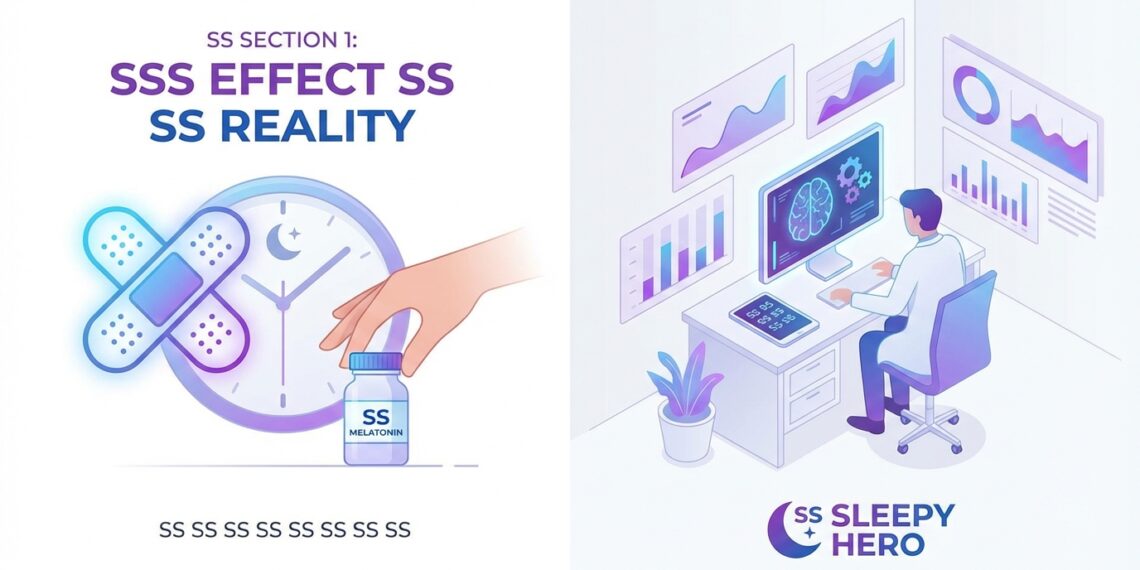
Section 1: The Band-Aid Effect and Clinical Reality
If you are struggling to achieve better sleep, reaching for an over-the-counter melatonin supplement seems like the most logical solution for a restless night.
Millions use this popular sleep aid hoping to fall asleep faster. But for elite biohackers and leading sleep clinicians, this common practice is fundamentally flawed.
The core issue is that melatonin treats the symptom, not the underlying cause of your chronic sleep issues.
Crucially, melatonin is not a sedative drug. It is the master sleep hormone released by the pineal gland that signals darkness, effectively regulating your internal body clock.
When chronic insomnia takes hold, the problem is rarely a simple deficiency in natural melatonin production.
The causes are typically complex, rooted in behavioral factors like poor light hygiene, chronic stress, or underlying systemic issues such as Hypothalamic-Pituitary-Adrenal Axis (HPA Axis) dysregulation.
When you introduce large, exogenous doses of the hormone via standard melatonin supplements, you risk confusing your natural Circadian Rhythm Regulation without addressing the actual triggers for poor sleep.
“Melatonin is an indicator of time, not an inducer of sleep. Relying on high-dose supplements prevents the user from seeking necessary behavioral and environmental corrections needed for long-term sleep health.”
This dependency creates what experts call the “band-aid effect.” It turns the supplement into a psychological crutch, delaying the necessary commitment to a holistic approach.
When users eventually attempt to discontinue use, the original sleep issues, fueled by underlying anxiety and poor habits, often return, making achieving deeper sleep feel impossible.
True sleep mastery requires learning how to improve sleep naturally.
Related Innovation
Hypertension therapy based on activity and circadian rhythm
According to an embodiment of a method for using an implantable device to deliver a hypertension therapy to a patient, an activity level is sensed using the implantable medical device. The implantable device may be programmed with a mapping of the sensed activity level to intensity levels for the …
Section 2: The Core Data Against OTC Melatonin Supplements
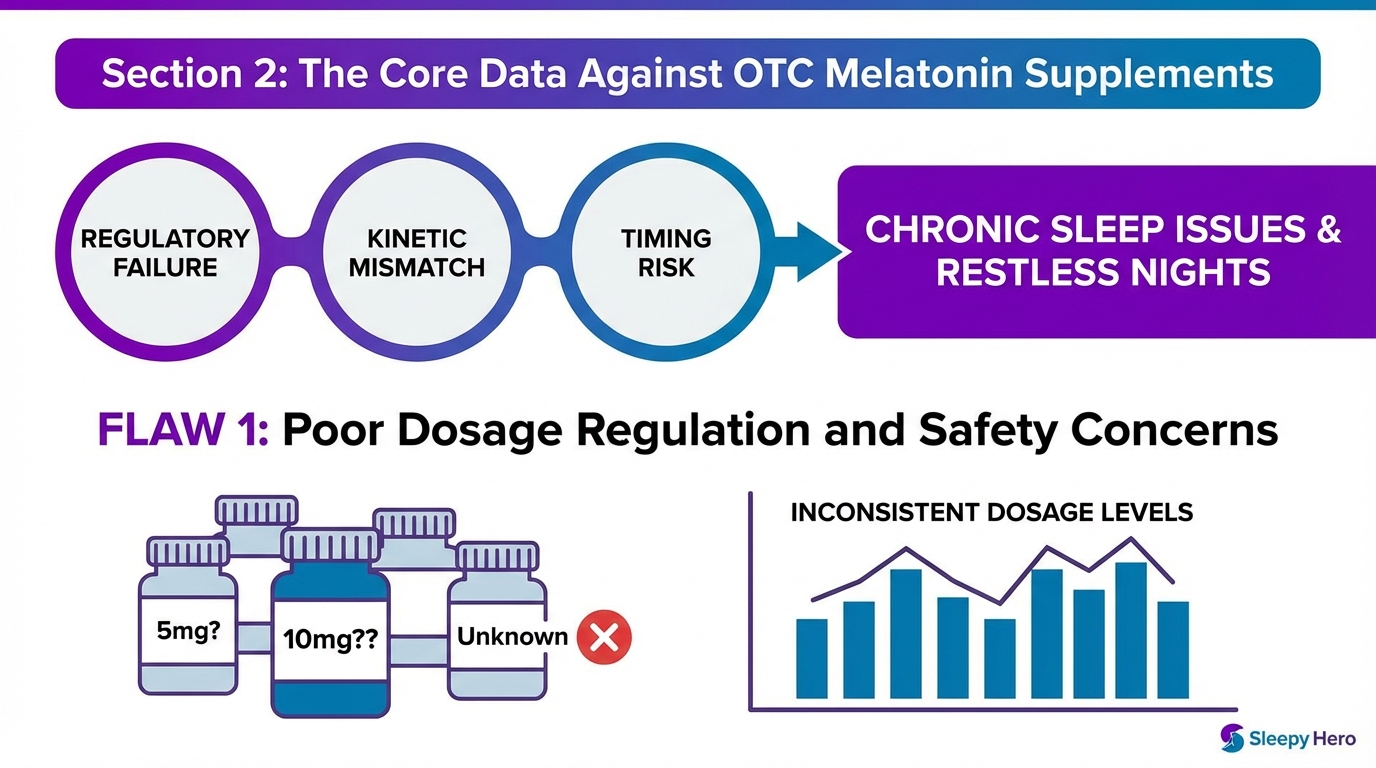
If OTC melatonin is merely a band-aid, what is the scientific evidence that proves it is ineffective or even counterproductive for long-term sleep health? The rationale for discontinuation is robust, centering on regulatory failure, kinetic mismatch, and timing risk.
These three issues explain why many people using this popular sleep aid continue to suffer from chronic sleep issues and a restless night.
Flaw 1: Poor Dosage Regulation and Safety Concerns
In the US market, melatonin is classified as a dietary supplement. This categorization means it completely bypasses the stringent quality control necessary for pharmaceuticals.
For a hormone that dictates your entire sleep-wake cycle, this lack of oversight is alarming.
Numerous clinical reviews have documented massive discrepancies between the label claim and the actual content of melatonin supplements. Some products contain negligible amounts, while others flood the system with up to 400 percent of the stated dose.
When you reach for that 3mg capsule expecting better sleep, you might unknowingly be consuming 15mg or more. This massive dose variability is a significant risk factor for unwanted melatonin side effects.
This lack of quality control makes precise dosing virtually impossible, preventing you from ever truly optimizing your sleep. You simply cannot master your sleep health if you do not know what dose you are consuming.
Flaw 2: The Kinetic Mismatch and Maintenance Insomnia
A primary complaint among those seeking a sleep aid is maintenance insomnia, the inability to stay asleep through the night, resulting in waking up at 2:00 AM or 3:00 AM.
Standard, immediate-release melatonin fails this test completely.
The half-life of oral melatonin is extremely short. It peaks quickly to help you fall asleep faster, but it clears the system within a few hours. By the time your body enters the crucial phases of deeper sleep later in the night, the supplemental hormone is gone.
If you take a dose at 10:00 PM and wake up distressed at 3:00 AM, the supplement offered zero support for the second half of the night.
This rapid clearance profile is a fundamental failure of Exogenous Supplement Pharmacokinetics when attempting to address complex, chronic sleep architecture problems.
Flaw 3: Phase Shifting and Circadian Disruption
The true power of the sleep hormone is its ability to signal darkness and shift the body clock. While useful for specific purposes like managing jet lag, using melatonin casually can be catastrophic for daily Circadian Rhythm Regulation.
Taking a large, unregulated dose of melatonin too late in the evening can push your entire circadian rhythm later. Clinicians call this a phase delay.
Instead of helping you achieve truly deeper sleep and wake up refreshed, you unintentionally worsen your natural rhythm. You become even more of a night owl, making it harder to wake up the next morning and perpetuating your underlying sleep issues.
True sleep mastery requires precise signaling, not a hormone flood that disrupts the subtle balance of the body’s internal clock.
The Disparity: Natural vs. Supplemental Melatonin
To understand the depth of this issue, it is crucial to compare the body’s natural production of this hormone versus the typical OTC supplement approach:
| Feature | Endogenous (Natural) Melatonin | Exogenous (Supplement) Melatonin |
|---|---|---|
| Source | Pineal Gland | Synthetic or Animal Source |
| Release Profile | Slow, sustained increase peaking mid-night | Rapid spike, quick clearance (Immediate Release) |
| Dosage | Microgram levels (0.1 to 0.3 mg equivalent) | Milligram levels (3 mg to 10 mg common) |
| Regulatory Oversight | Natural feedback loops | Minimal (Classified as a supplement in the US) |
| Primary Function | Signal darkness and synchronize the circadian rhythm | Attempts to force sleep onset |
The takeaway is clear: relying on high-dose, immediate-release melatonin supplements is counterproductive to the goal of achieving high-quality, sustainable sleep. The solution is not more hormones; it is learning how to improve sleep naturally.
Section 3: The Expert Protocol, Alternatives, and True Sleep Mastery
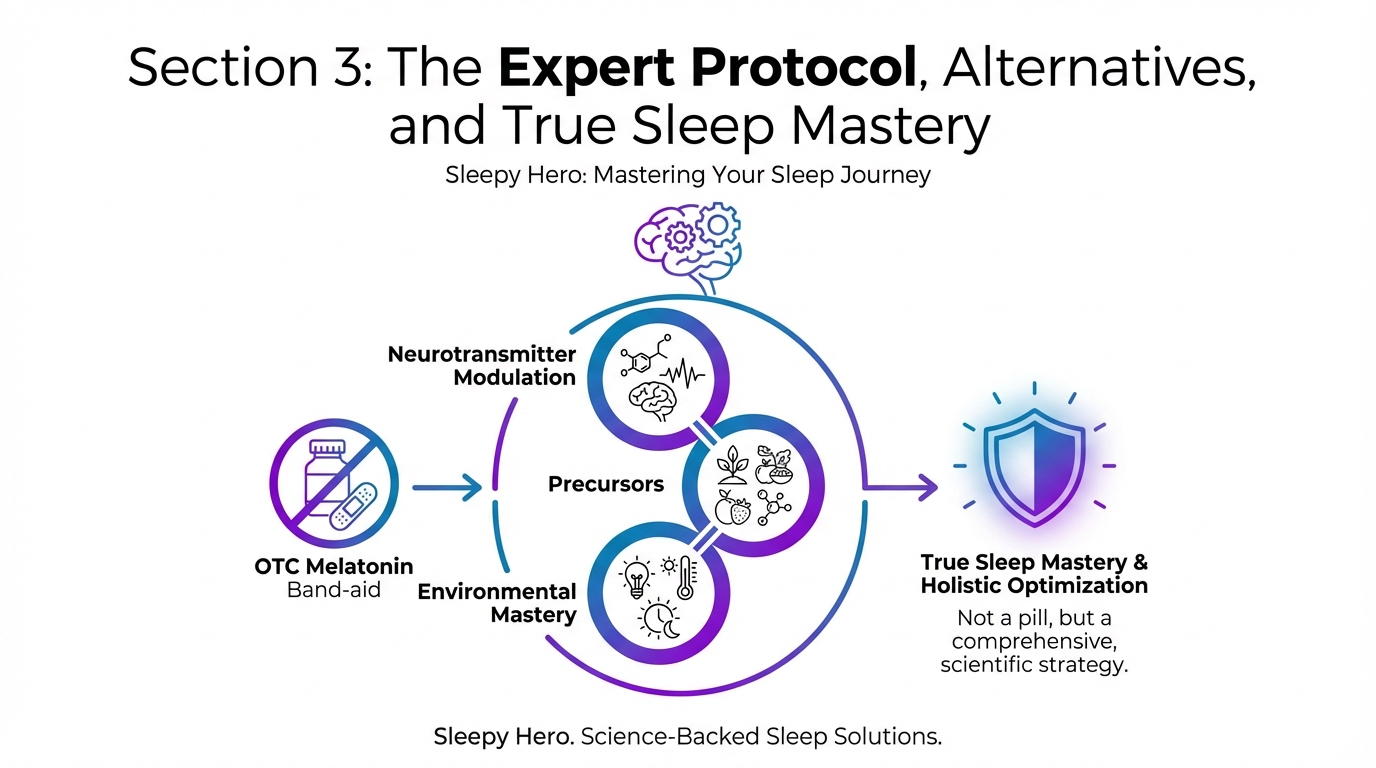
If OTC melatonin is merely a band-aid that fails to resolve chronic sleep issues, how do elite biohackers and clinicians achieve better sleep and resolve underlying sleep issues?
The answer is not a pill, but a comprehensive, scientific strategy focused on Neurotransmitter Modulation, precursors, and environmental mastery (the true Holistic approach to sleep optimization).
Mastering the Circadian Rhythm Regulation
The core component of true sleep mastery is mastering your environment. Light is the single most powerful tool for setting the Circadian rhythm and regulating the endogenous Sleep hormone.
You must use light exposure precisely to recalibrate your internal Body clock and improve sleep naturally.
Targeted Light Exposure Timing Protocol
-
- Morning Light: Seek 10 to 15 minutes of direct, bright sunlight immediately upon waking. This strong signal halts residual melatonin production and anchors your daytime cycle, helping you eventually fall asleep faster at night.
-
- Evening Darkness: Two to three hours before bed, eliminate bright white and blue light sources. Use red or amber light bulbs or specialized blue-blocking glasses. This allows your natural melatonin curve to rise unimpeded, signaling the brain to prepare for deeper sleep.
This strategy directly addresses the environmental factors that suppress natural melatonin, providing a far more powerful and sustainable path than relying on Melatonin supplements.
Nutritional Support and Neurotransmitter Modulation
Instead of flooding the system with synthetic hormones, experts focus on optimizing the neural environment that supports sleep initiation and maintenance.
This approach minimizes the risk of Melatonin side effects and dependency associated with chronic Sleep aid use.
Magnesium L-Threonate: The Calming Precursor
Magnesium L-threonate is a favored compound because it is one of the few forms of magnesium that effectively crosses the blood-brain barrier. It supports GABAergic activity, promoting relaxation and effective Neurotransmitter Modulation.
By dampening the nervous system overdrive, L-threonate helps alleviate the symptoms of a restless night, ensuring the brain can transition into restorative sleep cycles.
Addressing the HPA Axis and Stress Response
True sleep optimization must also tackle the chronic stress response, often mediated by the Hypothalamic-Pituitary-Adrenal Axis (HPA Axis).
Botanicals are gaining traction for modulating stress and sleep quality without the heavy sedative side effects of synthetic hormones.
Ingredients like Holixer, a high-quality holy basil extract, or specialized Saffron Extract are used to target stress and enhance resilience, supporting the body’s ability to transition into sleep naturally.
Leading sleep optimization companies, such as AVEA, recognize the flaws in relying on high-dose Melatonin. They have focused on non-melatonin formulas, such as the AVEA Sereniser, which utilizes these targeted nutrients to support endogenous sleep processes and achieve deeper sleep.
The Limited Role of Prescription Melatonin
There are specific, rare clinical cases where melatonin is appropriate, such as treating specific phase advance disorders or managing severe Jet lag.
In these instances, low-dose, time-released prescription formulations are preferred under medical supervision. This is distinct from standard Melatonin supplements.
Understanding Exogenous Supplement Pharmacokinetics
Why time-released? This formulation is designed to improve the Exogenous Supplement Pharmacokinetics.
It mimics the natural, sustained release profile of the pineal gland, helping to address maintenance insomnia and significantly reduce the risk of massive phase shifts that plague standard OTC options.
Crucially, these effective doses are often micro-doses, much lower than what is sold over the counter, sometimes as low as 0.3mg to 1mg. The goal is hormonal signaling for Circadian Rhythm Regulation, not sedation.
Even when prescription options are utilized, the primary focus must always remain on behavioral therapy, environmental control, and addressing the root cause of sleep issues.
True sleep mastery means ditching the crutch of the high-dose Sleep aid and building a resilient Body clock foundation.
Related Video
Conclusion: Mastering Sleep Requires a Holistic Approach
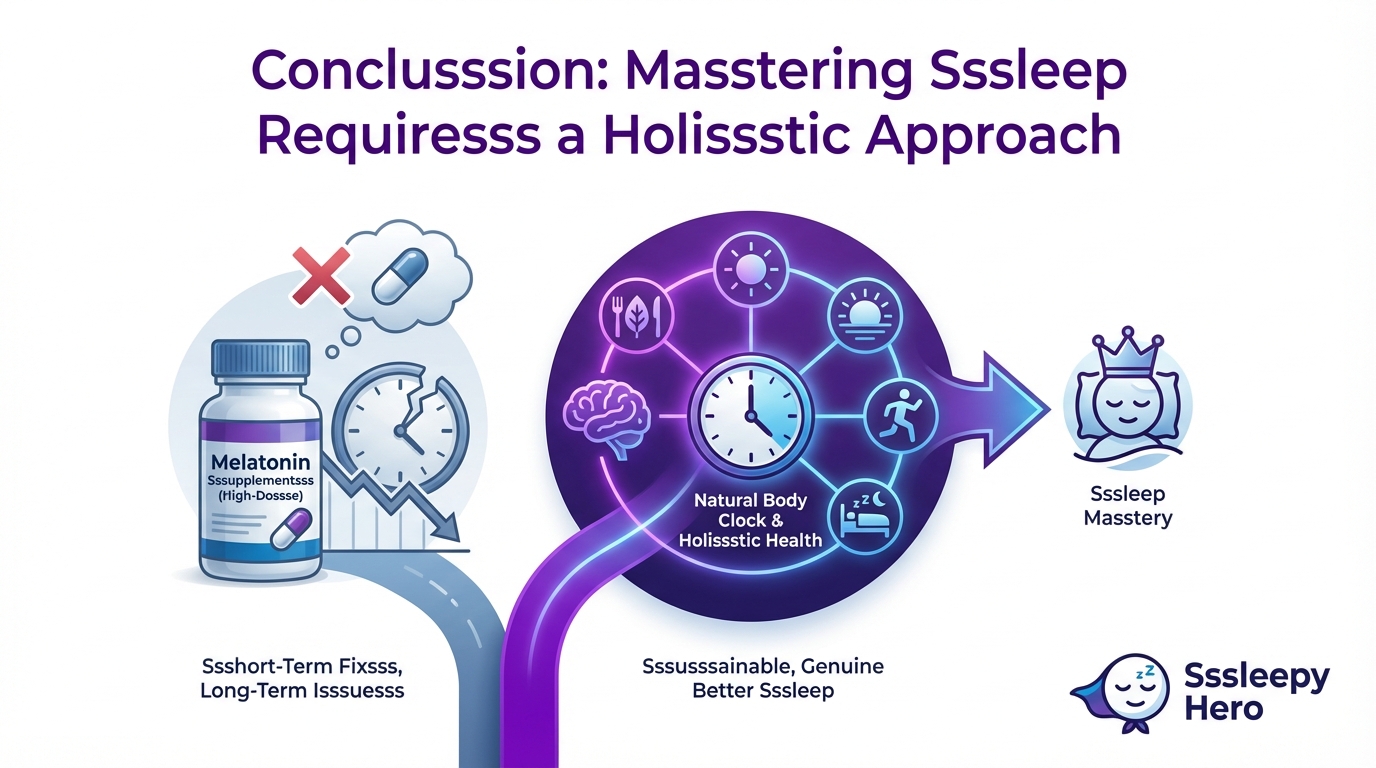
The seductive promise of quick, easy sleep via an over-the-counter sleep aid is powerful. However, the data confirms that high-dose, unregulated melatonin supplements are a poor substitute for true sleep optimization and often worsen underlying sleep issues.
Relying on an exogenous sleep hormone ignores the principles of Exogenous Supplement Pharmacokinetics and the complexity of your natural body clock.
If you want to achieve genuine better sleep, the solution is not more pills. The solution is discipline centered on Circadian Rhythm Regulation.
You must stabilize your sleep schedule, master light exposure timing, and ensure your nutritional foundation supports healthy Neurotransmitter Modulation.
This holistic approach addresses the root causes, ensuring that your sleep-wake cycle functions perfectly on its own. This is the only path to achieving genuine, sustainable deeper sleep without dependency.
Stop reaching for the band-aid and hoping to fall asleep faster. Start optimizing your life for sleep mastery and banish the restless night forever.
Related Video
Circadian Code to Extend Longevity | Satchin Panda …
Nurture your sleep and circadian rhythm by managing blue light, time restricted eating or intermittent fasting. Having a healthy circadian …
Watch Video on YouTube →
Frequently Asked Questions
Is it true that melatonin can make my body stop producing its own sleep hormone?
While the risk of complete, permanent suppression is highly debated, consistently using high-dose melatonin supplements (typically 3mg or more) can absolutely confuse your system. This exogenous input disrupts the sensitive feedback loop of the Hypothalamic-Pituitary-Adrenal Axis (HPA Axis) and the pineal gland, which regulates your natural sleep hormone production.
This is a core reason why reliance on a synthetic sleep aid often exacerbates underlying sleep issues rather than resolving them long-term.
How can I improve sleep naturally if I stop taking melatonin?
True sleep optimization relies on a holistic approach that addresses behavior and environment. To improve sleep naturally and achieve better sleep, focus on three key areas:
-
- Circadian Rhythm Regulation: Maintain consistent sleep and wake times (your body clock), even on weekends.
- Light Hygiene: Maximize bright light exposure early in the day, and implement a strict “zero blue light” rule two hours before bed.
- Neurotransmitter Support: Utilize targeted supplementation, such as Your Guide to the Best Natural Sleep Supplements, such as Magnesium L-threonate or Saffron Extract (supporting Neurotransmitter Modulation), to support GABA pathways, helping you fall asleep faster and achieve deeper sleep.
What is the difference between immediate release and time-released melatonin?
This difference is key to understanding Exogenous Supplement Pharmacokinetics. Immediate release causes a sharp, non-physiological spike in blood melatonin levels. Because of its short half-life, that level drops rapidly, leading to middle-of-the-night waking and a restless night.
Time-released formulations are engineered to mimic the body’s natural, slow-release curve, supporting sustained sleep. If you must use melatonin, the time-released format is pharmacologically superior, but precise, low dosing often requires clinical guidance.
Does melatonin help with jet lag?
Yes, managing jet lag is one of the few clinically validated uses for melatonin. When used correctly, it acts as a powerful signal to reset your body clock. However, it is a high-stakes protocol.
Dosing must be timed precisely based on the direction of travel and the desired phase shift. Taking it incorrectly can actively worsen symptoms by mistiming your circadian rhythm.
Are there any significant melatonin side effects I should watch out for?
Beyond failing to resolve underlying sleep issues, common melatonin side effects include significant morning grogginess (the “melatonin hangover”), vivid dreams, and daytime sleepiness.
Critically, due to the lack of FDA regulation for over-the-counter melatonin supplements, studies consistently find products containing wildly inaccurate dosages or undisclosed contaminants, leading to unpredictable effects.