Uvex Skyper S1933X (SCT-Orange amber lens)
Best for: Testing whether amber lenses work for you, before spending more
The amber wraparound the biohacker forums made famous — the cheapest evening lens we list, and the reason to pick it over TIJN's red lens is the seal-over-everything wraparound shape as much as the savings.
A safety glass, not eyewear: wraparound uni-lens, browguard, ANSI Z87.1 rated, and an SCT-Orange tint Honeywell says absorbs more than 98% of blue light. It became a sleep product by reputation rather than design — Honeywell sells it for screen comfort, while sleep researchers and biohackers adopted it because the amber lens and genuine peripheral coverage do the same job as glasses costing ten times more. Buy it to test the concept before spending on a premium pair.
Price & where to buy
Prices checked 2026-10-23Prices shown were last checked on 2026-10-23 and can change at any time — the price on the retailer's site at checkout is the one that applies. Product prices and availability are accurate as of the date/time indicated and are subject to change. Any price and availability information displayed on Amazon.com at the time of purchase will apply to the purchase of this product. As an Amazon Associate and affiliate we may earn a commission on purchases made through these links, at no extra cost to you.
How our prices work
We show the price at our recommended retailer as at our last check of that offer (2026-10-23) and, when Amazon reports one, its list price for comparison. Amazon prices come from Amazon's own product data service and are refreshed twice a day; each one shows the date and time Amazon gave it, and one older than 24 hours is replaced by “Check price”. Other retailers' prices are checked by hand and show the date of that check. Retail prices move constantly, so the price on the retailer's own page at checkout is the one that applies. More on Amazon prices
Should you buy it?
What we like
- The cheapest evening lens in the category by a clear margin
- True wraparound with browguard: real peripheral coverage
- ANSI Z87.1+2015 rated, anti-fog coated
- Lifetime frame guarantee from Honeywell
What to know before buying
- Honeywell markets it for computers, not sleep — the sleep case is third-party
- No wavelength range published behind the 98% figure
- Industrial looks; the main reason owners won't wear it around guests
- Will not fit over prescription glasses unless yours are very small
A darker, quieter bedroom, by the evidence.
Five short emails on light, noise and travel sleep: what the research supports, what to buy and what we would skip.
Free. Five short emails over two weeks, then about one a month. Unsubscribe any time.
At a glance
How it scores
How our 7.9/10 breaks down — rated on the dimensions that matter most for blue light glasses, from published specifications and third-party test data, not the marketing.
Featured in our guides
Buying guides that rank this product
Compare with alternatives
Quick verdicts for the blue light glasses most often considered alongside the Uvex Skyper S1933X (SCT-Orange amber lens).
Uvex Skyper S1933X (SCT-Orange amber lens) vs TIJN Sleep Glasses (Red-Tint, Blue+Green Blocking)
The cheapest true red tint — the lens class with the melatonin evidence, sold without a published transmission chart.
→ Evening screen users who want the evidence-backed tint at the lowest price
TIJN Sleep Glasses (Red-Tint, Blue+Green Blocking) review →Uvex Skyper S1933X (SCT-Orange amber lens) vs Spectra479 Fit-Over Nighttime Eyewear (amber)
The answer to the most common objection in this category — it slides straight over prescription glasses, with no clips.
→ Prescription and reading-glasses wearers
Spectra479 Fit-Over Nighttime Eyewear (amber) review →Uvex Skyper S1933X (SCT-Orange amber lens) vs SafetyBlue Sleep Savior Ultra (deep red)
The blocking-performance pick — one of the few here publishing separate blue AND green figures with wavelength bands.
→ Maximum blocking at a mid-range price, side-light sealing, the last hour before bed
SafetyBlue Sleep Savior Ultra (deep red) review →Not sure which one is right for you?
Our 60-second sleep score quiz asks 8 questions and recommends the right sleep gear for your goals. Free, no signup.
More blue light glasses we compared
See all →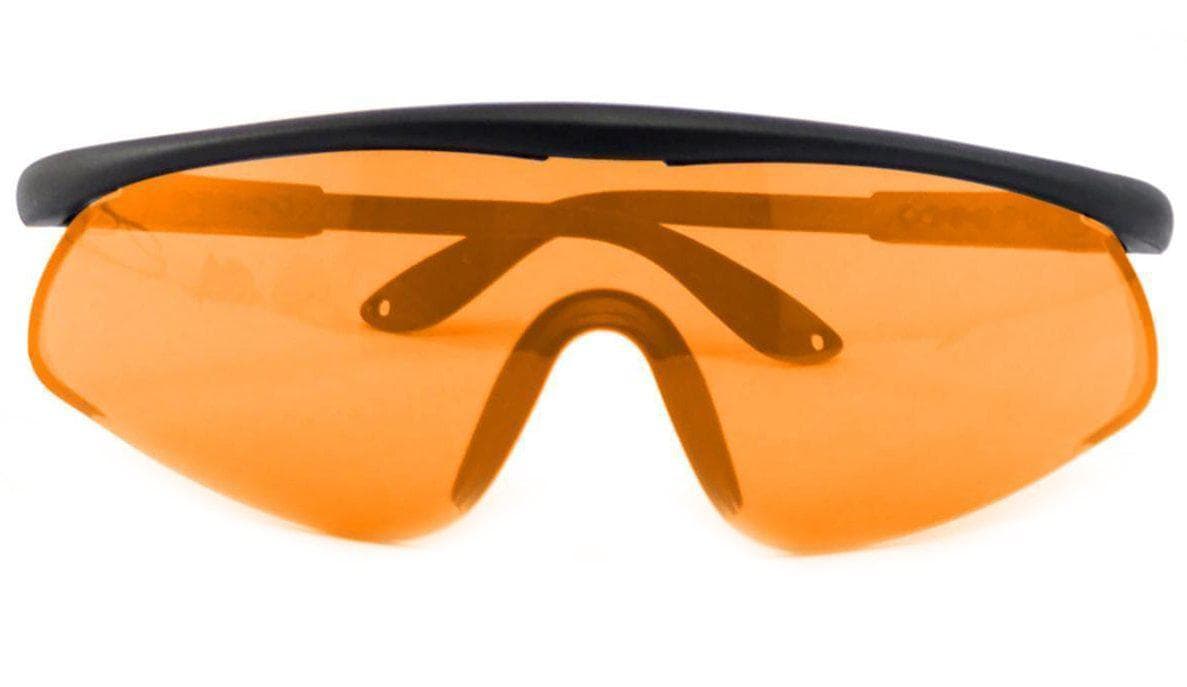
BlockBlueLight Original Blue Blocking Glasses (amber)

TrueDark Twilights Classic (deep red, foam barrier)
Swanwick Sleep Classic Night Swannies (amber)

GUNNAR Optiks Gaming & Computer Glasses
Frequently asked questions
Is the Uvex Skyper actually a sleep product?
Not according to Honeywell, who sell it for screen comfort at a computer. It became a sleep pick through third-party adoption — the SCT-Orange lens and wraparound coverage match what evening glasses do, at a fraction of the price. Judge it on the lens, not the marketing.
How does it compare to the TIJN sleep glasses?
TIJN is a red lens designed and sold for evening use; the Skyper is an amber safety lens adopted for it. The Skyper wraps further around the eye, which matters more than most people expect — light reaching you from the side is unfiltered in a flat frame.
What does "98% of blue light" actually mean here?
Less than it sounds. Honeywell publishes a percentage with no wavelength range, so there is no way to check which part of the spectrum it covers. Brands like SafetyBlue and BlockBlueLight publish per-band figures; Uvex does not. It's the weakest disclosure in our lineup.
Can I wear it over my prescription glasses?
Only if your frames are small. It isn't designed as a fit-over — for that, the Spectra479 fit-over is purpose-built and slides over Rx frames without clips.