Buying guide · updated 2026-08-04

Best blue light glasses for sleep — ranked by what the lens actually blocks

Almost every pair in this category makes the same claim — "blocks 99% of blue light" — and almost none of them tell you across which wavelengths. That gap matters more than price, because the light that shifts your body clock isn't only blue. The receptor responsible peaks around 480nm and stays sensitive past 500nm, well into green. A lens that stops at 500nm, which several popular amber pairs do, leaves part of the job undone. So we ranked these on what each brand publishes: the wavelength range, whether a transmission chart exists, and whether the numbers survive a second look. Two of the seven we examined publish real data. The rest ask you to trust a percentage. We've said plainly which is which — and flagged the brands claiming their glasses raise melatonin without publishing anything to support it.

Quick answer

The best blue light glasses for sleep are the TIJN Sleep Glasses — a genuine red lens, the tint class built to block blue and green, and the cheapest credible evening pair. Want maximum blocking? The SafetyBlue Sleep Savior Ultra covers 570nm at a mid-range price. Wear prescription glasses? The Spectra479 fit-over slides over them for a fraction of what Swanwick charges for its Fitover.

Edited by Logan Foley, CSSC·Editorially selected against published specs

The full breakdown

Every pick reviewed

#1 · Best overall

TIJN Sleep Glasses (Red-Tint, Blue+Green Blocking)

A genuine red lens that costs less than any other purpose-built evening pair here.

TIJN Sleep Glasses (Red-Tint, Blue+Green Blocking)
Editor score8.3/10
$17.99$25.99
(Amazon Prime member price as of – Details)Shop at best price →Full review →

Most of the affordable end of this category is daytime computer glasses wearing a sleep label. The TIJN is not: it's a deep red-tint lens sold specifically for evening screen use, the tint class built to block both blue and green wavelengths, and it costs a fraction of the branded pairs. That combination is why it's the pair our readers buy more than any other.

What you don't get is evidence. TIJN publishes no wavelength range and no transmission chart, so the blocking claim rests on the tint being visibly deep rather than on data. At this price that's a defensible trade — you're risking very little to find out whether evening lenses help you. At Swanwick's price it wouldn't be.

Buy it as the default starting point. If it works and you want something better made, the Swanwick is the fashion upgrade and the SafetyBlue is the performance one.

Pros

  • ✓True red tint, not a light amber
  • ✓Cheapest purpose-built evening pair here — the lowest risk
  • ✓Sold for evening use, not repurposed from gaming glasses
  • ✓Ordinary frame shape you can wear indoors without comment

Cons

  • ✗No published wavelength range or transmission chart
  • ✗Flat frame lets side light through
  • ✗No fit-over version we could verify — glasses wearers look elsewhere
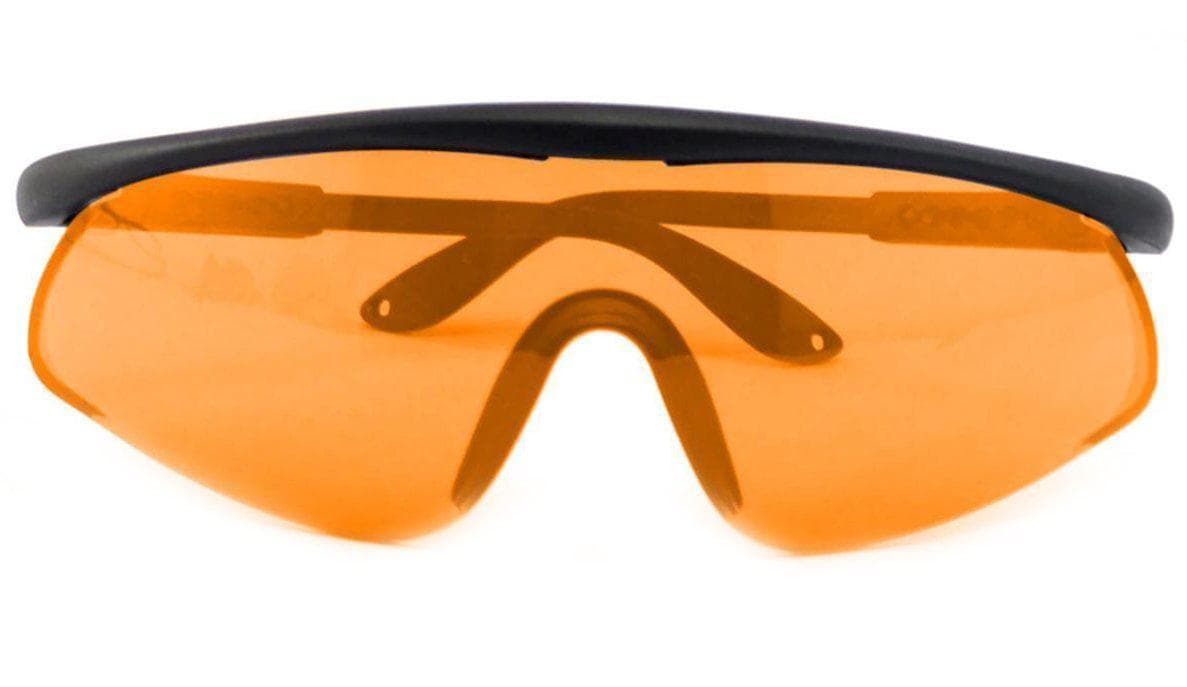
#2 · Best blocking for the money

SafetyBlue Sleep Savior Ultra (deep red)

Publishes separate blue and green figures with the wavelength bands attached, both near-total by the brand's numbers.

SafetyBlue Sleep Savior Ultra deep red night glasses
Editor score8.6/10
$59.95
(Amazon price as of – Details)Shop at best price →Full review →

SafetyBlue does the thing almost nobody else in this category does: it breaks the claim down by band. 99.9% across 450-495nm for blue, 99.7% across 495-570nm for green, and full UV coverage from 280-400nm. Whether or not you can independently verify those figures — and you can't, because there's no transmission chart — the specificity itself is informative. Brands with something to hide round to one number.

That 570nm ceiling is the practical advantage. It covers the whole range your body clock responds to, where Swanwick's amber stops at 500nm and Spectra479's tops out near 510nm. SafetyBlue says the Ultra's removable foam gasket seals the gap around the frame, addressing the light leak a flat frame leaves open.

The cost is wearability. The brand says colour distortion is severe and prohibits driving. These are for the last hours indoors, and they look like sport wraparounds. If that's acceptable, this is the most lens per dollar here.

Pros

  • ✓Per-band figures with wavelength ranges, not a single rounded number
  • ✓Covers green to 570nm — wider than any amber pair here
  • ✓Removable foam gasket around the frame, per the brand
  • ✓Enclosed, padded fit, per the brand

Cons

  • ✗Severe colour distortion; the brand prohibits driving in them
  • ✗No transmission chart, so the precise figures can't be checked
  • ✗Replacement gaskets are sold separately
#3 · Best if you wear glasses

Spectra479 Fit-Over Nighttime Eyewear (amber)

The only pair here that slides over prescription frames with no clips.

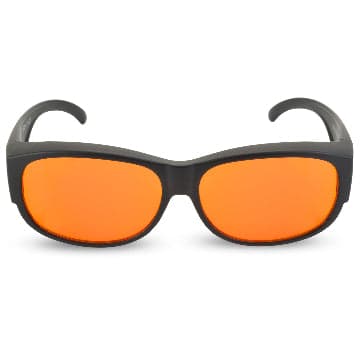
Spectra479 fit-over amber nighttime eyewear
Editor score8.1/10
$39.85
(Amazon price as of – Details)Shop at best price →Full review →

If you wear glasses, most of this category is simply unavailable to you, and the usual workaround — clip-ons — means fiddling with your own frames every night. The Spectra479 is a shell that goes over what you're already wearing, for a fraction of what Swanwick charges for its equivalent.

The lens is amber rather than red, with a site-level claim of 100% blocking from 280-490nm and 99.8% across 450-510nm. Note where that stops: 510nm leaves most of the green band through. It's a lighter intervention than a red lens, which also means it's easier to wear for a couple of hours without the world turning crimson.

One honest gripe: those blocking figures appear only in the product page's meta description, not in the visible page body. A buyer landing there sees no spec at all, which is a strange choice for a product whose entire premise is a mechanism.

Pros

  • ✓Genuinely fits over prescription frames — no clips
  • ✓A fraction of the price of Swanwick's fit-over
  • ✓Not dark-tinted, so non-blue light still passes through
  • ✓90-day returns

Cons

  • ✗Blocking figures aren't shown on the product page itself
  • ✗Amber capped near 510nm — misses most of the green band
  • ✗Protective case costs extra
#4 · Most transparent

BlockBlueLight Original Blue Blocking Glasses (amber)

The only cheap pair publishing a real transmission chart — and the only one that admits what it fails to block.

BlockBlueLight Original amber blue blocking glasses
Editor score8.4/10
Check price
Shop at best price →Full review →

BlockBlueLight puts a lens transmission report on the product page: 100% of blue across 400-500nm, and a 43% reduction of green across 500-570nm. Read that second figure again — it's the brand telling you, in its own marketing, that most green light gets through its amber lens. Nobody else in this category volunteers a limitation.

That honesty is the reason it's here. In a market where the standard is an unsourced round number, a brand that publishes a chart and concedes a weakness is doing something genuinely useful for buyers. Their pricier red NightFall line covers 400-550nm fully if you want the wider band from the same people.

The practical catch: there's no Amazon listing, so you buy direct with no Prime shipping. And like several others here, the brand's copy claims the glasses increase melatonin levels — a causal claim it publishes nothing to support, and one we're not repeating.

Pros

  • ✓Publishes an actual lens transmission chart
  • ✓States what it doesn't block, not just what it does
  • ✓Wraparound with side coverage at a mid-pack price
  • ✓100% blue blocking across the full 400-500nm band

Cons

  • ✗No Amazon listing — brand-direct only
  • ✗43% green blocking is genuinely partial
  • ✗Repeats an unsupported melatonin claim
#5 · Best budget test

Uvex Skyper S1933X (SCT-Orange amber lens)

A real amber wraparound at the lowest price in this guide — the cheapest honest way to find out if this works for you.

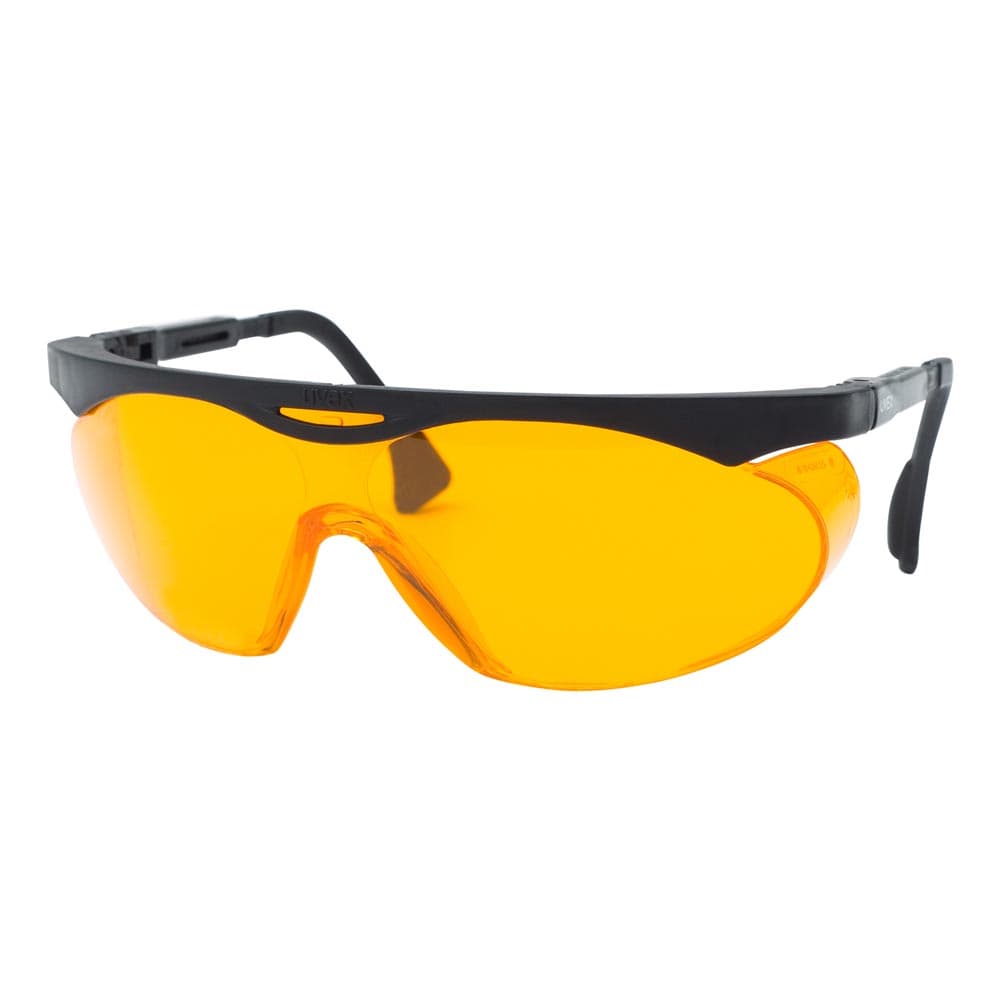
Uvex Skyper S1933X amber safety glasses
Editor score7.9/10
$12.36$16.88
(Amazon price as of – Details)Shop at best price →Full review →

The Skyper is a safety glass. Honeywell sells it for screen comfort at a computer, and says nothing about sleep. It ended up in this category because sleep researchers and biohackers noticed that an SCT-Orange lens absorbing more than 98% of blue light, in a wraparound frame with a browguard, does the same job as glasses costing ten times more.

We've included it on that basis and we're not going to pretend otherwise: the manufacturer's positioning is daytime, the sleep case is third-party, and the 98% figure comes with no wavelength range whatsoever — the weakest disclosure of anything here.

What it is, unambiguously, is the cheapest way to run the experiment. Wear it for two weeks in the evening. If your sleep improves, buy something you'd be willing to be seen in. If nothing changes, you've spent very little finding out.

Pros

  • ✓The lowest price in this guide — the lowest-risk entry in the category
  • ✓True wraparound with browguard: genuine peripheral coverage
  • ✓ANSI Z87.1 rated with anti-fog coating
  • ✓Lifetime frame guarantee

Cons

  • ✗Honeywell markets it for computers, not sleep
  • ✗No wavelength range behind the 98% claim
  • ✗Industrial looks — the main reason owners stop wearing it
#6 · Best for night waking

TrueDark Twilights Classic (deep red, foam barrier)

Violet, blue and green blocking behind a built-in foam seal — for the 3am bathroom trip that ends your night.

TrueDark Twilights Classic deep red night glasses
Editor score8.3/10
$165.00
(Amazon price as of – Details)Shop at best price →Full review →

Most sleep glasses solve the evening-screen problem. TrueDark solves a narrower one: you wake at 3am, walk to the bathroom, flip on a bright light, and your night is over. The Twilights Classic is built for that moment, with a deep red lens claiming 99% of blue, green and violet, behind a foam barrier that closes the gap between frame and face.

It costs several times the TIJN, and the evidence doesn't scale with the price. "Blue, green and violet" names three colours; it isn't a wavelength range, and there's no transmission chart. The brand also claims an EEG-verified study showing the glasses shift brainwave states — we looked and could not find it published anywhere.

Buy it if night waking is your actual problem and the seal is worth the money. For evening screens, cheaper pairs here do the job.

Pros

  • ✓Widest blocking claim here — violet as well as blue and green
  • ✓Foam light seal built into the frame
  • ✓Hard case and lens cloth both in the box
  • ✓Purpose-built for night waking, not just screens

Cons

  • ✗Several times the price of the TIJN and well above the SafetyBlue
  • ✗Colour names instead of a wavelength range; no chart
  • ✗The EEG study it cites isn't published anywhere we could find
Free, by email
Free · no card

A darker, quieter bedroom, by the evidence.

Five short emails on light, noise and travel sleep: what the research supports, what to buy and what we would skip.

Free. Five short emails over two weeks, then about one a month. Unsubscribe any time.

Buying criteria

What actually matters in a pair of sleep glasses

1.The wavelength range — not the percentage

"Blocks 99% of blue light" is close to meaningless without a range attached, because brands choose which slice of the spectrum to measure. The number that matters is where the blocking stops. The melanopic response that tells your brain it's daytime peaks near 480nm and extends past 500nm into green light. Swanwick blocks to 500nm. BlockBlueLight's amber reaches 500nm fully then drops to 43% through the green band. SafetyBlue covers to 570nm. TrueDark claims violet, blue and green but publishes no range at all. When a brand gives you a percentage without a range, treat it as marketing.

2.Amber or red — and be honest about which you'll wear

Red lenses block more of the relevant spectrum than amber, and they distort colour badly enough that SafetyBlue prohibits driving in them. That's the trade: the more effective the lens, the less wearable it is outside the last hour or two before bed. Amber is the compromise most people actually keep using. The best pair is the one still on your face at 10pm, not the one with the widest spectrum sitting in a drawer.

3.Coverage around the frame, not just through it

A tinted lens only filters what passes through it. Light arriving from above, the side, or a lamp behind you reaches your eye unfiltered in a flat frame. This is the most overlooked spec in the category. Wraparounds (Uvex, SafetyBlue, BlockBlueLight) address it with shape; TrueDark builds in a foam barrier; SafetyBlue says its Ultra has a removable foam gasket, with replacements sold separately. Fashion frames like the Swanwick look better and seal worse — a real trade-off, not a defect.

4.Whether it fits over prescription glasses

Roughly six in ten adults wear corrective lenses, and most pairs in this category simply don't accommodate them. Only one here does: the Spectra479 fit-over. Swanwick sells a dedicated fit-over that costs far more. If you wear glasses, this single question eliminates most of the market before price enters the conversation.

5.What the brand claims versus what it can show

Several brands here state their glasses increase melatonin production. None of them publish a study of their own product supporting it. Swanwick cites a SleepScore Labs result it commissioned; TrueDark cites an EEG study we could not find published anywhere. That doesn't make the products bad — blocking evening light is a reasonable thing to do regardless — but it does mean the physiological claims are advertising. Buy the lens for its measured transmission, not for a promised hormone response.

People also ask

Frequently asked questions

Do blue light glasses actually help you sleep?

Blocking short-wavelength light in the evening is a sound idea — that light suppresses melatonin and delays sleep onset, which is well established. Whether a specific pair of glasses delivers a measurable benefit depends on how much of the relevant range it blocks, and most brands won't tell you. Treat them as one input alongside dimming your room, not a substitute for it.

What wavelengths do sleep glasses need to block?

The receptor that signals daytime to your body clock peaks near 480nm and stays sensitive past 500nm into green light. So a lens covering 400-500nm handles most of the job, and one reaching 550-570nm covers effectively all of it. Any brand quoting a percentage without naming a range is telling you nothing checkable.

Amber or red lenses — which is better for sleep?

Red blocks more of the relevant spectrum, amber is more wearable. Red lenses distort colour severely enough that SafetyBlue prohibits driving in them, so they suit the last hour or two before bed. Amber is the compromise most people keep using night after night, which usually matters more than the extra coverage.

How long before bed should I wear them?

Brands here recommend anywhere from 30 minutes (TrueDark) to two hours (Spectra479), with 90 minutes the most common guidance. Earlier is more conservative. If you use them only for the last ten minutes before lights-out, you're unlikely to notice much.

Can I just use night mode on my phone instead?

Night mode shifts your screen warmer, which helps, but it only addresses one light source. Your overhead lights, kitchen, and bathroom are usually brighter than your phone and unaffected by it. Glasses cover everything you look at — which is also why dimming the room is the better first move if you can do it.

Do these glasses increase melatonin?

Several brands claim so, and none publish a study of their own product supporting it. Swanwick cites research it commissioned; TrueDark cites an EEG study we could not find published. Blocking evening light is reasonable on its own merits — but the hormone claims in this category are advertising, not evidence.

More buying guides

All buying guides →
Mattresses

Best mattress for hot sleepers — cooling beds compared by sleep editors

Cooling tech

Best cooling mattress pads for hot sleepers — active systems and passive pads compared

Humidifiers

Best humidifiers for a baby nursery — cool-mist, quiet, and easy to clean

Cooling tech

Best Eight Sleep alternatives — bed cooling without the Autopilot membership

Sleep masks

Best sleep masks for side sleepers — thin and contoured picks the pillow won't shove into your face

Sleep sacks

Best sleep sacks for winter — ranked by TOG rating and real cold-room warmth

Wedge pillows

Best wedge pillows for snoring (and the reflux that often comes with it)

Sleep earplugs

Best reusable earplugs for sleeping: washable, low-profile, and honest about what they block

Bedroom fans

Best quiet fans for sleeping: bedroom fans that cool on high and disappear on low

Sleep trackers

Best sleep trackers without a subscription — full data, no monthly fee

Sleep trackers

Best smart rings without a subscription — full data, no monthly fee

Sound machines

Best white noise machines for babies — continuous sound you can keep at a safe nursery volume

Cervical pillows

Best cervical pillow for side sleepers — 5 compared by shoulder-gap fit

Sleep headphones

Best sleep headphones for side sleepers — the flattest, no-pressure picks

Mattresses

Best flippable mattress — the two-sided beds worth buying, and the one-sided alternatives if you only need one firmness

Silk pillowcases

Best silk pillowcases for hair and skin — real mulberry, ranked by momme weight

Pillows

Best cooling pillows — ranked by construction, not by the word on the box

CPAP comfort

Best CPAP pillows for side sleepers — ranked by how well the cutouts actually clear your mask

Mattresses

Best mattress for side sleepers — 2026 picks compared by sleep editors

CPAP comfort

Best CPAP comfort accessories — 7 cheap fixes matched to the 5 complaints CPAP users actually have

Pillows

Best pillow for side sleepers — compared on loft, support, and neck alignment

Sheets

Best cooling sheets — compared on breathability and moisture-wicking

Sleep earplugs

Best earplugs for light sleepers — ranked by how much noise they actually block

Weighted blankets

Best cooling weighted blankets for hot sleepers — ranked by how well they shed heat

Blackout curtains

Best blackout curtains for day sleepers and shift workers — ranked by true light blocking

Sunrise alarms

Best sunrise alarm clocks for heavy sleepers — ranked by brightness, ramp, and backup alarm

Mattress toppers

Best mattress toppers for side sleepers — ranked by shoulder-and-hip pressure relief

Knee pillows

Best knee pillows for side sleepers — ranked for keeping your hips stacked

Editorial process

Edited by Logan Foley, CSSC. Picks are editorially selected against published specs, verified pricing, and category-specific criteria. Amazon prices come from Amazon's own product data service, are refreshed twice a day and show the date and time Amazon gave them; one older than 24 hours is replaced by “Check price”. Other retailers' prices are checked by hand. We never show a discount we cannot verify. Only Amazon, Layla and Promeed pay us; other brand-direct links earn us nothing.

SleepyHero is a participant in the Amazon Services LLC Associates Program. Purchases via our links help fund our reviews at no cost to you. Product prices and availability are accurate as of the date/time indicated and are subject to change. Any price and availability information displayed on Amazon.com at the time of purchase will apply to the purchase of this product.