
Buying guide · updated 2026-10-16

Best wedge pillows for snoring (and the reflux that often comes with it)

Snoring gets worse flat on your back because gravity pulls the tongue and soft palate into the airway. A wedge changes the angle of the whole upper body, which is why it is studied for sleep apnea and for night-time reflux rather than sold as a comfort item. In a sleep-laboratory study, raising the head of the bed by a modest 7.5 degrees reduced the apnea-hypopnea index from 15.7 to 10.7 events an hour, and in reflux patients a 20 cm head-end lift cut recumbent acid exposure and shortened the time acid stayed in the oesophagus. A wedge pillow is the cheapest way to get that geometry without a bed frame. The catch is that most people buy one too tall and too firm, sleep on it for three nights, and put it in a closet. We ranked the three below on the height and firmness owners actually keep using, on who each one is built for, and on whether you can buy it today; the direct-only Helix Wedge is covered in the questions at the end.

Quick answer

The best wedge pillow for snoring for most people is the Kolbs Bed Wedge: a 7.5-inch slope with a memory-foam top, the gentlest height that still lifts the airway, and the one new wedge users tolerate. Need to find your own angle? The Lunix LX5 set stacks. Nightly reflux as well as snoring? The MedCline system. Want a trial period first? The Helix Wedge, sold direct and reviewed on its own page.

Edited by Logan Foley, CSSC·Editorially selected against published specs

The full breakdown

Every pick reviewed

#1 · Best for most snorers: the gentle 7.5-inch start

Kolbs Bed Wedge Pillow, Standard 7.5"

The lowest, friendliest incline that still lifts the airway, with a memory-foam top over a high-density core.
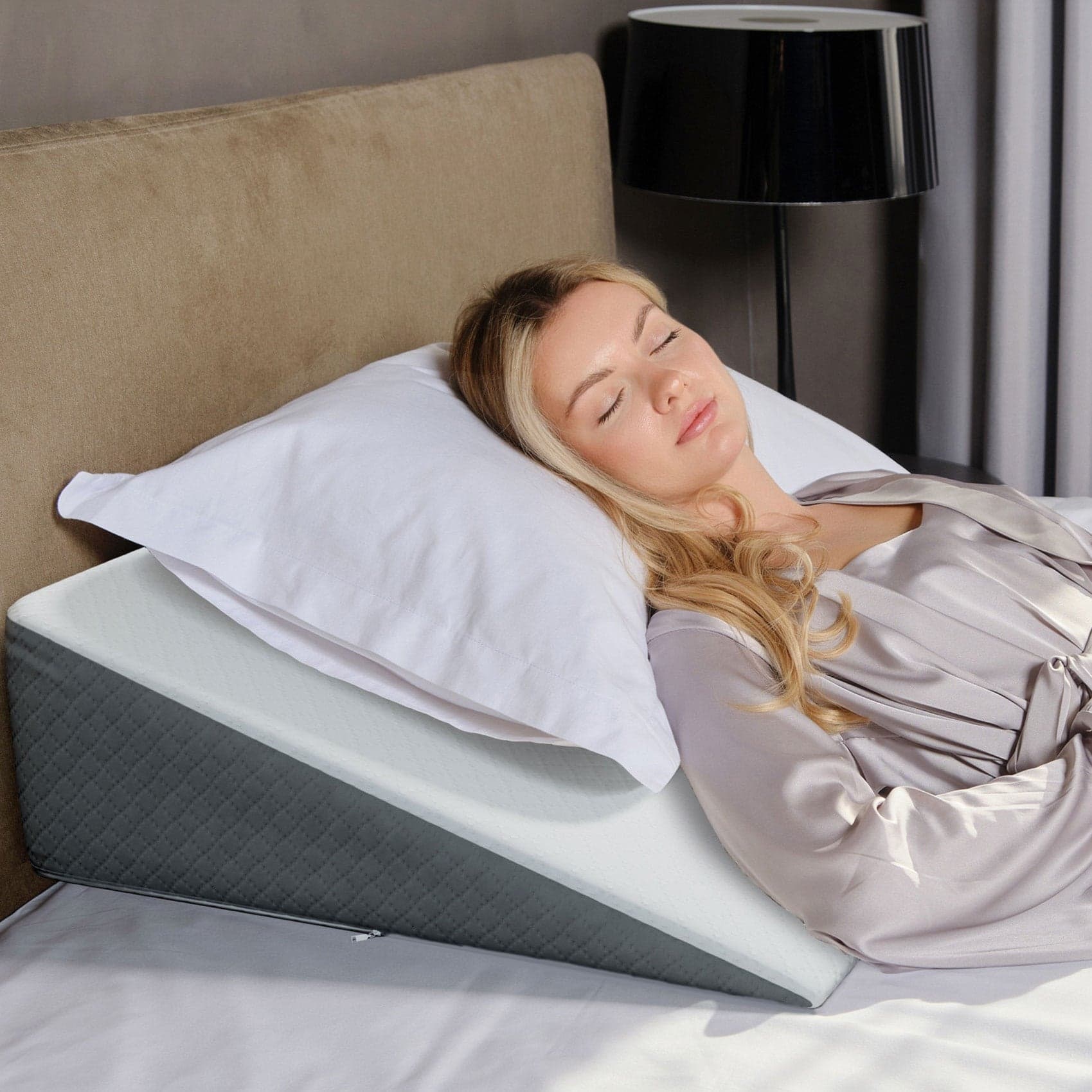
Kolbs Bed Wedge Pillow, Standard 7.5-inch, in use
Editor score7.8/10
$39.99$42.59
(Amazon Prime member price as of – Details)Shop at best price →Full review →

The Kolbs Bed Wedge is our pick for most people who snore because it gets the one decision right that sinks most first wedges: height. Its 7.5-inch slope is the gentle end of the category, close in spirit to the modest elevation used in the apnea study rather than the steep ramps that owners slide off. The top is about 1.5 inches of memory foam over a high-density support core, which takes the edge off the firmness without letting the wedge collapse, and the jacquard cover zips off for the wash. Kolbs also sells 12-inch and extra-wide versions under the same name, so check the listing title before you buy.

Owner feedback is split in a way that tells you who it is for. People who wanted a plush pillow call it a rock; people who bought it to stop snoring or reflux and gave it a week tend to stay. The listing is marked FSA-eligible, and it sells on Amazon, which is not true of every wedge on this page.

Pros

  • ✓7.5-inch slope: the easiest height to adapt to, and the one most owners keep using
  • ✓About 1.5 inches of memory foam over a supportive high-density core
  • ✓Removable, washable jacquard cover; 12-inch and extra-wide versions exist
  • ✓Listed as FSA-eligible

Cons

  • ✗Firmer than a pillow buyer expects; the like-a-rock complaints are the main negative
  • ✗Some owners still find the incline abrupt despite the modest height
  • ✗No trial period; the Amazon return window is what you get
#2 · Best adjustable: find your angle instead of guessing it

Lunix LX5 4-Piece Orthopedic Set

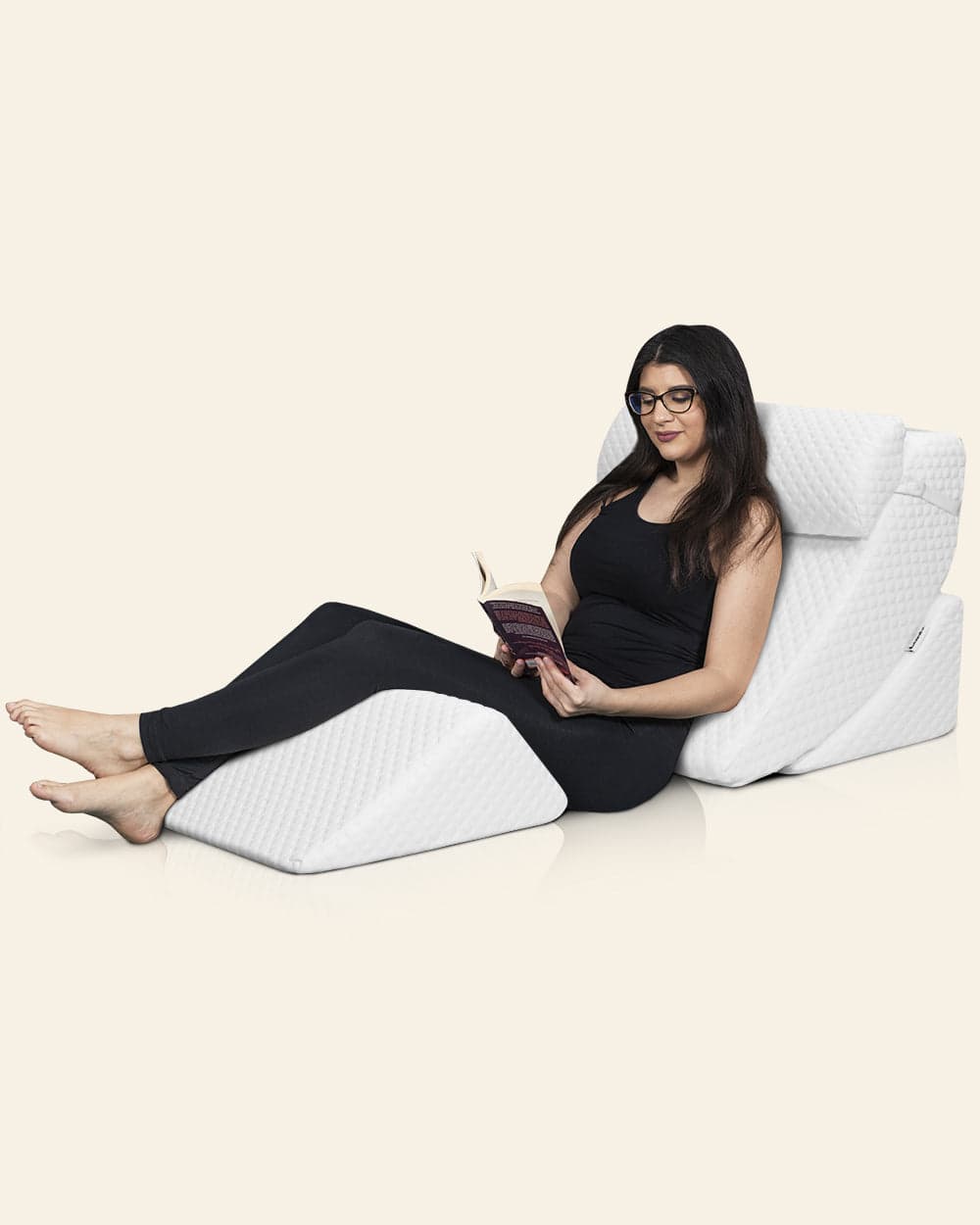
Four stackable foam pieces let you change the incline week by week, which no single-height wedge can do.

Lunix LX5 4-piece orthopedic wedge pillow set in use
Editor score8.0/10
$159.97
(Amazon price as of – Details)Shop at best price →Full review →

The Lunix LX5 is a four-piece system rather than a wedge: a base wedge, a back wedge, a head pillow and a knee pillow, all in 45-density OEKO-TEX memory foam with washable covers and an anti-slip strap that keeps the head pillow in place. For snoring that matters because the right angle is personal. Stack the two wedges for a steep lift on the worst nights, use the base alone for a gentle one, and add the knee pillow to stop yourself sliding down, which is the complaint that defeats most single wedges.

It is also the pick for anyone recovering from surgery who needs to sleep raised for a few weeks and then wants the pieces to earn their keep afterwards. The cons are practical: the rear wedge can migrate overnight for restless sleepers, the foam runs firmer than some expect, and a few owners report a missing piece on delivery, so check the box when it arrives.

Pros

  • ✓Restackable pieces: change the incline as you learn what stops the snoring
  • ✓45-density OEKO-TEX memory foam with removable, washable covers
  • ✓Head pillow anchors with a Velcro strap; hot/cold pack and storage bags included
  • ✓FSA/HSA-eligible with a letter of medical necessity, per Lunix

Cons

  • ✗The rear wedge can shift overnight if you move a lot
  • ✗Firmer than expected for a meaningful share of owners
  • ✗Scattered reports of a missing piece on delivery
#3 · Best for reflux plus snoring: an incline that holds you on your left side

MedCline Reflux Relief System

The only pick built around both findings in the reflux research: head-of-bed elevation and left-side sleeping, held all night.

MedCline Reflux Relief System in use for left-side inclined sleeping
Editor score8.4/10
$269.98
(Amazon price as of – Details)Shop at best price →Full review →

The MedCline Reflux Relief System is a three-piece wedge, insert and body pillow that keeps you at a 15 to 20 degree incline and on your left side, the position the reflux literature associates with less acid exposure. It is sized by your height, FDA-registered as a device, and FSA/HSA eligible. If your snoring comes with nightly heartburn, this is the pick; if you only snore, it is more system than you need and it takes about half of a queen bed, which your partner will notice.

Owners describe a real adjustment period: repositioning at night is hard by design, and the arm pocket puts pressure on the elbow for some. Those who get past the first week report genuine relief, which is the pattern you would expect from a product that works by restricting movement. On our worth-the-money list it rates as worth it on sale, and only for diagnosed reflux; for plain elevation, a simpler wedge does the geometry.

Pros

  • ✓Holds inclined left-side sleeping all night, the position reflux studies point to
  • ✓Sized by user height; FDA-registered device; FSA/HSA eligible
  • ✓CertiPUR-US certified gel foam
  • ✓Owners who get past the adjustment period report genuine reflux relief

Cons

  • ✗Occupies about half a queen bed
  • ✗Hard to reposition at night, and the arm pocket can press on the elbow
  • ✗More than a snorer without reflux needs, and priced like it

Related

All wedge pillows we cover →

Every wedge with its height, foam, cover and where it is sold, including the Brentwood Zuma and the InteVision.

Helix Wedge Pillow review →

The direct-only wedge with a 30-night trial and free returns, reviewed on its own page.

Snoring solutions, ranked by evidence →

Position, nasal strips, mouthpieces and when to get assessed for sleep apnea.

Best cervical pillows for side sleepers →

If side sleeping on its own quiets the snoring, a contoured pillow keeps you there.

Free, by email
Free · no card

Get your pillow and bed setup right.

One practical idea at a time for neck, back, heat and snoring, plus what we would skip and why.

Free. Five short emails over two weeks, then about one a month. Unsubscribe any time.

Buying criteria

What makes a wedge pillow work for snoring

1.Height: start lower than you think

Wedges are sold at 7, 7.5, 10 and 12 inches. The sleep-lab evidence for snoring and mild apnea used a modest elevation of 7.5 degrees, not a steep one, and the most common one-star complaint across every wedge we cover is that the incline felt like a cliff and the sleeper slid down it. A 7 to 7.5-inch wedge is the right first purchase for snoring; 10 inches suits reflux sleepers who need a stronger lift; 12 inches is for experienced wedge users only, which is why the 12-inch InteVision is not a pick here despite its clever two-pillow headrest.

2.Firmness: a comfort layer matters more than the brand

A wedge has to be firm to hold its angle, so the difference between one you keep and one you return is the top layer. The Kolbs puts roughly 1.5 inches of memory foam over its support core, the Helix uses 1.5 inches of gel-infused memory foam, and the Lunix pieces are 45-density memory foam throughout. Brentwood Home's Zuma, a one-piece 30 ILD foam block with no comfort layer, is the budget option for people who already know they want firm; its owners describe it as solid as a rock, and they mean it both ways.

3.Snoring or reflux: they want different shapes

For snoring, a straight incline is enough: the goal is to keep the head and chest raised so the airway stays open on your back. For night-time reflux the research adds a second variable, sleeping on the left side, which is why the MedCline is shaped to hold you there and why it occupies about half a queen bed. If your problem is snoring alone, a MedCline is more wedge than you need. If you wake with heartburn as well, it is the only pick built around both findings.

4.Where to buy it, and whether you can send it back

All three picks sell on Amazon with the usual return window, and all three are listed as FSA-eligible, so a health spending account may pay for them (Lunix says its wedges need a letter of medical necessity). The Helix Wedge is not on Amazon at all: it is sold only by Helix, with a 30-night trial, free returns and a 1-year warranty, and a wedge is exactly the kind of product people give up on in week two. It is not ranked here because we rank only what you can buy through a listing we have checked; it has its own review.

People also ask

Frequently asked questions

Does a wedge pillow actually help snoring?

For snoring that is worse on your back, yes, within limits. Raising the head and chest widens the upper airway, and in a sleep-laboratory study a modest 7.5-degree head-of-bed elevation reduced the apnea-hypopnea index from 15.7 to 10.7 events an hour and improved minimum oxygen saturation. A wedge recreates that angle on an ordinary bed. It will not fix snoring caused by nasal blockage or by alcohol, and loud snoring with pauses in breathing should be assessed for sleep apnea rather than managed with a pillow.

What height wedge pillow is best for snoring?

Start at 7 to 7.5 inches. The research used a modest elevation, the gentle wedges are the ones owners keep using, and the most common reason a wedge gets returned is that the incline was too steep to sleep on. Move up to 10 inches only if the lower height stops the snoring but you want more lift, or if reflux is part of the picture. Twelve inches is for experienced wedge sleepers.

Wedge pillow or an adjustable bed?

They do the same thing to your airway; the bed does it for your whole body and costs many times more. A wedge is the right first step because it tells you whether elevation helps you at all. If it does and you fight the slide-down every night, an adjustable base or bed risers under the head end of the frame are the longer-term answer.

Can I use the same wedge for acid reflux?

Yes, and most buyers do. Head-of-bed elevation reduced oesophageal acid exposure and acid clearance time in a trial of nocturnal reflux patients, and a systematic review found the effect consistent across the studies it included, with a caution that the evidence base is small. For reflux the research adds left-side sleeping, which is what the MedCline system enforces and a plain wedge does not.

Why do people slide down wedge pillows?

Because a slope with a slick cover and a heavy sleeper on it behaves like a slide. The fixes, in order: a lower wedge, a knee pillow or a stacked set like the Lunix that supports the legs, a cover with some grip, and a fitted sheet pulled over the wedge and the mattress together so the two cannot separate.

Is the Helix Wedge Pillow good for snoring?

On specification, yes: 24 by 24 inches and 10 inches tall, with 1.5 inches of gel-infused memory foam over a high-density base, a washable cover and USA manufacturing, and it runs cooler than the budget foam blocks. What sets it apart is the 30-night trial with free returns and the 1-year warranty, which turn the biggest risk in this category, giving up in week two, into a refund. It is sold only by Helix, not on Amazon; it comes in one height with no gentler option; lightweight side sleepers find it too firm; and it costs roughly double a basic foam wedge. It is not in the ranking above because we rank only what you can buy through a listing we have checked, and our full review covers it on its own page.

Is the InteVision wedge not recommended any more?

It is a good wedge with a clever adjustable headrest, but at 12 inches it is the aggressive end of the category and its Amazon listing has had no purchasable offer since early September 2026. We will put it back in the running when the listing returns and if you already own one, the headrest pillow is the feature to keep using.

More buying guides

All buying guides →
Sleep trackers

Best sleep trackers without a subscription: band, watch, ring or bed pad

Mattress toppers

Best firm mattress toppers, ranked for a mattress that has gone too soft

Mattresses

Best mattress for hot sleepers — cooling beds compared by sleep editors

Cooling tech

Best cooling mattress pads for hot sleepers — active systems and passive pads compared

Humidifiers

Best humidifiers for a baby nursery — cool-mist, quiet, and easy to clean

Cooling tech

Best Eight Sleep alternatives — bed cooling without the Autopilot membership

Sleep masks

Best sleep masks for side sleepers — thin and contoured picks the pillow won't shove into your face

Sleep sacks

Best sleep sacks for winter — ranked by TOG rating and real cold-room warmth

Sleep earplugs

Best reusable earplugs for sleeping: washable, low-profile, and honest about what they block

Bedroom fans

Best quiet fans for sleeping: bedroom fans that cool on high and disappear on low

Sleep trackers

Best smart rings without a subscription: RingConn Gen 3, Gen 2, Gen 2 Air and Galaxy Ring

Sound machines

Best white noise machines for babies — continuous sound you can keep at a safe nursery volume

Cervical pillows

Best cervical pillow for side sleepers — 5 compared by shoulder-gap fit

Sleep headphones

Best sleep headphones for side sleepers — the flattest, no-pressure picks

Mattresses

Best flippable mattress — the two-sided beds worth buying, and the one-sided alternatives if you only need one firmness

Silk pillowcases

Best silk pillowcases for hair and skin — real mulberry, ranked by momme weight

Pillows

Best cooling pillows — ranked by construction, not by the word on the box

CPAP comfort

Best CPAP pillows for side sleepers — ranked by how well the cutouts actually clear your mask

Blue light glasses

Best blue light glasses for sleep — ranked by what the lens actually blocks

Mattresses

Best mattress for side sleepers — 2026 picks compared by sleep editors

CPAP comfort

Best CPAP comfort accessories — 7 cheap fixes matched to the 5 complaints CPAP users actually have

Pillows

Best pillow for side sleepers — compared on loft, support, and neck alignment

Sheets

Best cooling sheets — compared on breathability and moisture-wicking

Sleep earplugs

Best earplugs for light sleepers — ranked by how much noise they actually block

Weighted blankets

Best cooling weighted blankets for hot sleepers — ranked by how well they shed heat

Blackout curtains

Best blackout curtains for day sleepers and shift workers — ranked by true light blocking

Sunrise alarms

Best sunrise alarm clocks for heavy sleepers — ranked by brightness, ramp, and backup alarm

Mattress toppers

Best mattress toppers for side sleepers — ranked by shoulder-and-hip pressure relief

Knee pillows

Best knee pillows for side sleepers — ranked for keeping your hips stacked

Sources

  1. [1]Souza FJFB, Genta PR, de Souza Filho AJ, Wellman A, Lorenzi-Filho G. The influence of head-of-bed elevation in patients with obstructive sleep apnea. Sleep Breath. 2017;21(4):815-820. View source ↗
  2. [2]Khan BA, Sodhi JS, Zargar SA, et al. Effect of bed head elevation during sleep in symptomatic patients of nocturnal gastroesophageal reflux. J Gastroenterol Hepatol. 2012;27(6):1078-1082. View source ↗
  3. [3]Albarqouni L, Moynihan R, Clark J, Scott AM, Del Mar C. Head of bed elevation to relieve gastroesophageal reflux symptoms: a systematic review. BMC Fam Pract. 2021;22:24. View source ↗

Editorial process

Edited by Logan Foley, CSSC. Picks are editorially selected against published specs, verified pricing, and category-specific criteria. Amazon prices come from Amazon's own product data service, are refreshed twice a day and show the date and time Amazon gave them; one older than 24 hours is replaced by “Check price”. Other retailers' prices are checked by hand. We never show a discount we cannot verify. Only Amazon, Layla and Promeed pay us; other brand-direct links earn us nothing.

SleepyHero is a participant in the Amazon Services LLC Associates Program. Purchases via our links help fund our reviews at no cost to you. Product prices and availability are accurate as of the date/time indicated and are subject to change. Any price and availability information displayed on Amazon.com at the time of purchase will apply to the purchase of this product.